Beyond the Manual: Why Learning by Doing Beats Perfection
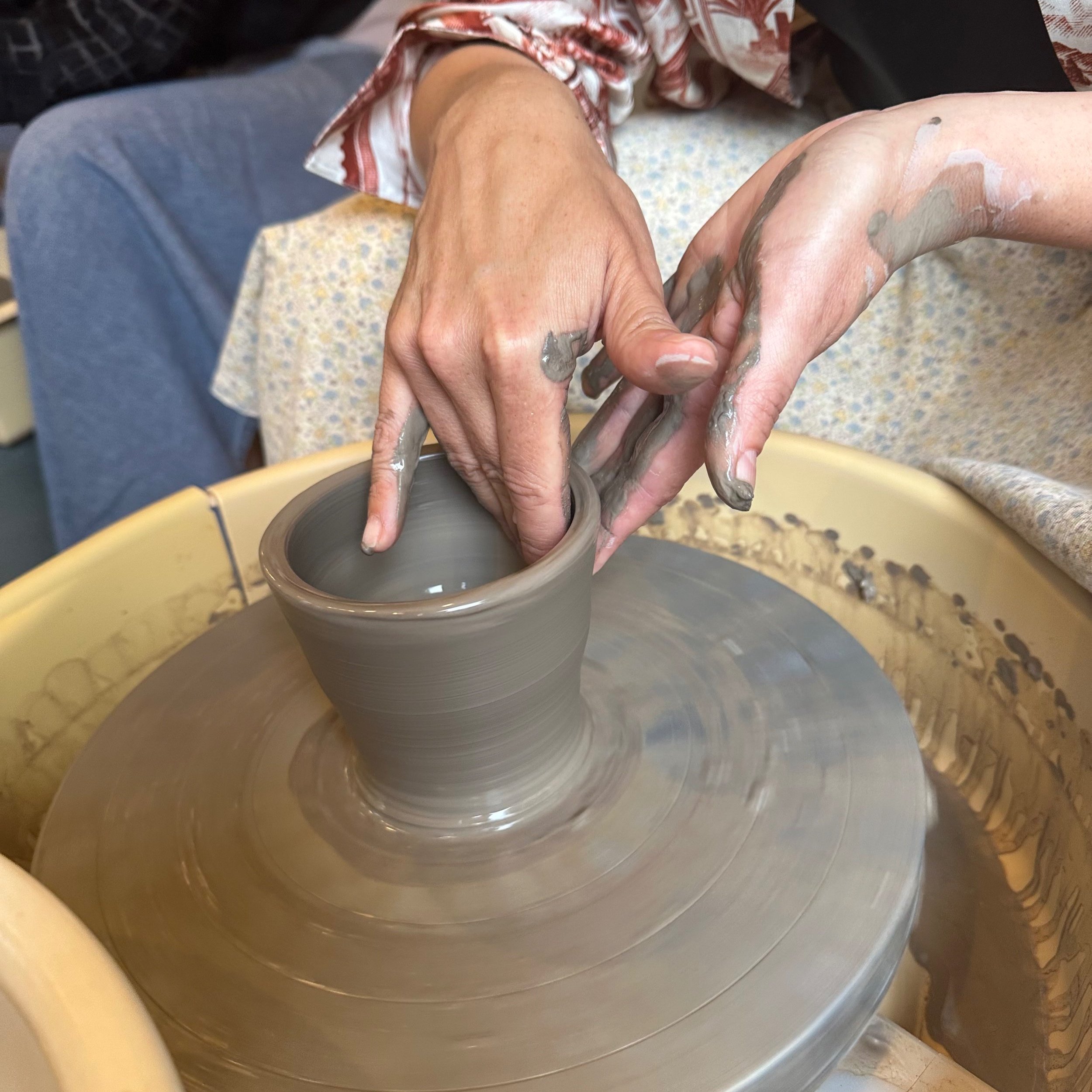
First attempts at pottery when visiting Kyoto, JP
On a walk the other day, a friend told me about her adventure of building an Ikea cupboard without closely looking at the manual. It resulted in her having to take apart the side panels to screw them back together differently, making the screws visual on the outside, and her husband mad.
Yet, as the storm of different approaches was blowing through, she got inspired to overpaint the surface of the cupboards entirely with a double-coated technique they had seen on a recent trip while staying in a cottage by the sea.
It's given the furniture a Mediterranean whitewashed look that uplifted the complete interior of the room and rekindled the mood of the relationship, as the result is echoing the joyful memories of their vacation.
When equally impatiently ditching the instructions the other day, I ended up with a soup that was meant to be a baked vegetable dish. It's become a new favorite and put me back into explorer mode when cooking, sparking playful culinary joy where it had felt blandly repetitive lately. It's made me ponder:
What if setting the manual aside puts us back in touch with the power of explorative action, taking us beyond the limitation of known rules?
Admittedly, not everything that has gone pear-shaped in my life has also had a silver lining. At least not initially.
Yet, over time, those relationships that didn't work out brought me closer to the relationship with myself. And as it's the most consistent relationship we will ever have, it might have been exactly what was needed to align with my deepest personal growth.
The several jobs I've had, and the countries I've lived in have resulted in feeling at home in diverse places. More profoundly though, they have been my parcours to become more agile as a way of being in the world.
Continually challenging my resistance to change has made me more flexible regarding the unknown, as I realize that unlearning what I felt certain of expands my knowledge beyond the outdated scripts I'm dragging along on my journey.
Learning by doing is the art of living beyond the building-up of the CV we tend to describe as our life.
It's about stretching our limiting points of view like training a muscle. It's about increasing our capacity to roll with the punches—our ability to surf the waves of whatever matrix we are currently plugged into. A bit like being inserted into a game by life, as it knows we are ready to play the next level.
What if the obstacle is the path after all?
What if, as Zen culture suggests, the path isn't meant to be something neatly laid out for us, but something that unfolds through the act of walking it?
Think about it: from those first wobbly steps as a toddler to navigating your life self-sufficiently, it's been a considerable amount of "learning by doing," falling and getting up, getting it “wrong” to figure out what works better. The blunders, blemishes, and scars alchemyzing your lessons into the capacity to tackle your daily challenges more skilfully.
We don't tend to read a manual on how to ride a bike, rather wobble along until we find our balance. I still vividly remember when an aunt had "secretly" let go when I was learning to cycle. I beamed when I realized I had actually done it, and amusingly fell off and cried when I rationally caught up with her "betrayal."
Similarly, we don't tend to intellectualize our personal style when small. As soon as we get to interfere with well-planned outfits, our exasperated parents might find themselves challenged to release us into the world with mismatched socks, the favorite dragon-summer sweater in winter, and a glittery tulle skirt intended for Halloween. It's how we build a wardrobe that feels like "us,” until the opinions of our peers, advertisements, and social “shoulds” add literal layers to our explorations.
When given space to learn on the go, we learn to trust our innate capacity to figure things out for ourselves, which is an effective self-expansive strategy to gain confidence.
Learning: It's All About the Building Blocks
When I learned Spanish, the teacher I started off with refused to work with translation. It was daunting at first, the way she was cheerfully chatting along while I was out at sea trying to catch the gist.
It turned out rather quickly, though, that by barreling past my desire for definitions, her method unhooked me from my mental blockages.
As she skipped the explanations and went straight to the core, she taught me the language by being immersed in it fully. With her refusal to yield, I unflatteringly wobbled along, grappling with doubt, frustration, and vulnerability—to surprise myself as I got more eloquent the more I kept going.
It was like a modular system, where we set up a grid with simplest building blocks and then added complexity. It took me from ordering a coffee with just three words, to gradually expanding my vocabulary as I got more confident.
Numbers and measurements I learned in the garment development factories where the enthusiastic staff taught me while we were doing fittings. This hands-on approach in a real-world context proved encouragingly effective, as the logic of using what I was learning made it stick.
As Benjamin Franklin said: ”Tell me and I forget, teach me and I remember, involve me and I learn."
This isn't just anecdotal; science backs it up!
Neuroplasticity—our brain's ability to rewire itself throughout life—means that when we engage in repetitive practice, we literally build and strengthen new neural pathways.
It's what's captured by the neuroscientific principle that "neurons that fire together, wire together." It's how we move from clumsy attempts to smoother actions.
Encouragingly, studies support that even when we feel like we've hit a wall, consistent practice has been shown to lead to significant improvements in performance—sometimes much better than we perceive.
Our brains are always learning, even when we don't realize it.
Think of it like walking through untouched grass. The first time, you just push through, leaving barely a mark. But by continuously taking that little trail, it eventually becomes clearly visible and might end up being your new default track.
The Surprising Power of Doing It Badly
Inspiringly, my experience all over the world has been that when we make the effort to order something with a considerably twisted sentence, people encouragingly support us as we lean into their world.
The dread of being laughed at for not getting it right is one of the things I've encouragingly been most wronged about by life.
I guess, as we all know how intimidating it can be to join a new team at work, get stuck in a presentation, or fall off a surfboard in front of a packed beach, we tend to remember each other’s humanness when someone is risking to be a beginner again.
We appreciate courage as we recognize it as a challenging state asking us to face our fear.
It’s why we tend to be impressed when someone dares to get lost by exploring unknown territory instead of becoming spellbound by a map. It’s why we are supportive when someone falls when taking a leap instead of evading to get bruised.
While preparation is unskippable, any hike only truly becomes clear by doing it.
It’s often more efficient to have a look around that next corner rather than twisting a digital map with complex graphics that might require a legend or a degree to interpret. Even the most meticulous plan can’t bypass real-time conditions like weather, fitness, or territory having shifted due to an avalanche.
Steve Jobs, the visionary behind Apple, was famous for his belief in “intuitive user interfaces.”
His philosophy was that you shouldn't need a thick manual to use a device, rather be able to unpack it and figure it out by using it. This approach is powerfully mirrored in the way an iPhone tells you what to do as soon as you turn it on, getting you engaged as you use it.
Can Theory Ever Prepare Us for Real Life?
A friend of mine is a fighter pilot in the military who undergoes countless training scenarios in flight simulators.
Modern technology, like virtual reality, provides safe "learning by doing" environments in fields like medicine or aviation, enhancing problem-solving skills in safe territory.
Yet, as effective as he admits this training to be, my friend claims that no instruction could ever prepare him for real situations he is faced with, as the real-life-interaction comes with real-life hiccups: The unexpected cramp you have in your leg, the little irritating spot that somehow got onto the visor of your helmet, yesterday’s discussion with your boss that you can't mentally shake.
No theory can prepare us for the unpredictability of a multifaceted reality, regardless of how immaculate the preparation.
Michael Singer said so pointedly in Living Untethered that the whole world is a giant Rorschach test.
The psychological test has you looking at ambiguous inkblots and describing what you see. There's no "right" answer. What you perceive reveals your inner world decoded by your mind, regardless of the inkblot itself. It's where some people might see a threatening skull and others see a butterfly.
It's an impactful reminder how our perceptions are subjective, depending on our conditioning, mindset, and state of the moment. It's why learning by doing is not just about external action but about how we subjectively interpret and respond to the "inkblots" of life.
The Necessity of Doing It Badly (Until You Do It Well)
Often, the most direct way to learn is to do things poorly until we improve. It's about counting on stumbling, falling, getting up, and gradually getting better with practice.
We advance as we dare. And when we dare, we often take ourselves to that surprising realization that what seemed daunting three tries ago suddenly is doable.
It's like a dance of taking the leap, noticing when we lose courage, taking a side step, at times looping back, and trying anew.
Admittedly, this technique requires us to live with the discomfort of not being good at something initially. It’s the reason my uncle did not actually use his new laptop for half a year after buying it, as he paralyzed himself with reading instructions, opening the package months after purchase.
From my own experience, driving on the left side of the road, having learned in a country where driving on the right side is default, feels uncomfortable each time I start off again in Ireland.
No amount of reading can replace the jitters that will simply be part of the ride for a while until passengers no longer have to endure my self-talk to correctly enter roundabouts and avoid the wrong side of the road when taking a too broad left turn.
Paradoxically, we seem to become more uncomfortable to expose ourselves to being bruised the more comfortable we let ourselves get.
The longer I don't drive on the other side, the more apprehensive I get. The longer I skip a day of writing, the blanker the page appears to be. The longer I refrain from a run, the steeper the hill seems that is part of the trail.
It’s why our much-proclaimed comfort-zone has a reputation of getting us stuck, as we yield from the edge of the adventure, simultaneously yielding from growth.
The Power of Apprenticeship
Although I formally studied garment engineering and fashion design, I learned most from my apprenticeships—making clothes from scratch at a tailor.
Nothing taught me more about the body, clothes, and human nature than fittings. It's the culmination of co-creating from different angles of interest—one focused on development, the next on cost, the next on design, while a bride is having an emotional meltdown due to her anxiously plummeting weight requesting a re-fit she does not have time for in her meticulous pre-nuptial schedule.
Many friends have praised apprenticeship as experience being the best teacher, as the famous proverb suggests.
A childhood friend learned carpentry directly from experienced professionals, owning a prospering business today, never having finished school. Medical residencies allowed several friends to gain hands-on experience treating patients under supervision, realizing what directions they are most equipped for. A neighbor who is an aspiring chef started as a line cook and built his own style through everything he learned in his culinary school-of-life class, as he likes to point out.
Why it Works: The Brain's Superpower
Hands-on learning physically changes your brain owed to neuroplasticity—the brain's incredible ability to rewire itself throughout the ever-changing landscape of our life.
For example, when learning to play an instrument, initial practice forms new connections. These connections become stronger over time until aspects like where to place your fingers on a key of the piano automize.
Over time the brain pathways become so well-established that you stop consciously telling yourself to move a finger on your violin string, as it starts to flow of its own accord.
It's how I learned touch typing on the computer—starting off painstakingly slow with scanning the keyboard for where to place each finger according to a set pattern. It's what's taken me to keeping my eyes fixed on the screen as the words flow similarly as when writing by hand.
It can be hugely inspiring to watch a child pick up an instrument or athletic practice and see how quickly they go from single exercises to a whole routine.
Active participation is a self-propelling feedback loop providing quick adjustments to improve.
We tend to build confidence by daring to give it a shot.
The courage comes with the leap, not before.
We learn swimming by swimming, cooking by cooking, writing by writing, and become skilled at communicating by bravely leaning towards life's offerings, even unprepared.
Each experience builds momentum and provides new information for future steps.
It’s a self-expanding mechanism, almost like the energy of a perpetuum mobile—constantly creating and recreating itself through action. In a way, it's a self-fulfilling prophecy to the degree that we dare engage.
Learning by doing is the quiet wisdom of the journey being the reward. It's the experience that the best way to live our lives is by engaging with the moment. Learning to live by living.
Give it a Try:
Brush your teeth with your non-habitual hand. Admittedly, I did get toothpaste all over myself the first attempts, but ever since, it's been surprisingly familiar to switch the motion.
Try something you never felt you could accomplish, like knitting, or pottery, or playing a video game. Notice how a totally unfamiliar idea can become a surprisingly familiar motion by staying with it.
Give a language you don't know a go and aim for 3–5 brief sentences you try out in real life. Notice how quickly you can expand your building blocks as your knowledge expands as life reaches back to you.
Give these thoughts some attention:
Does the idea of "doing it badly until you get better" keep you from trying in the first place?
What is the worst thing that could happen? Is it more bearable than you might think?
What do you lose if you don't try?
What have you learned by simply doing it without theoretical instructions?
How has embracing imperfection affected your confidence?
How do you balance the need for preparation with learning as you go?