What If We’re Indeed More Than the Sum of Our Parts?
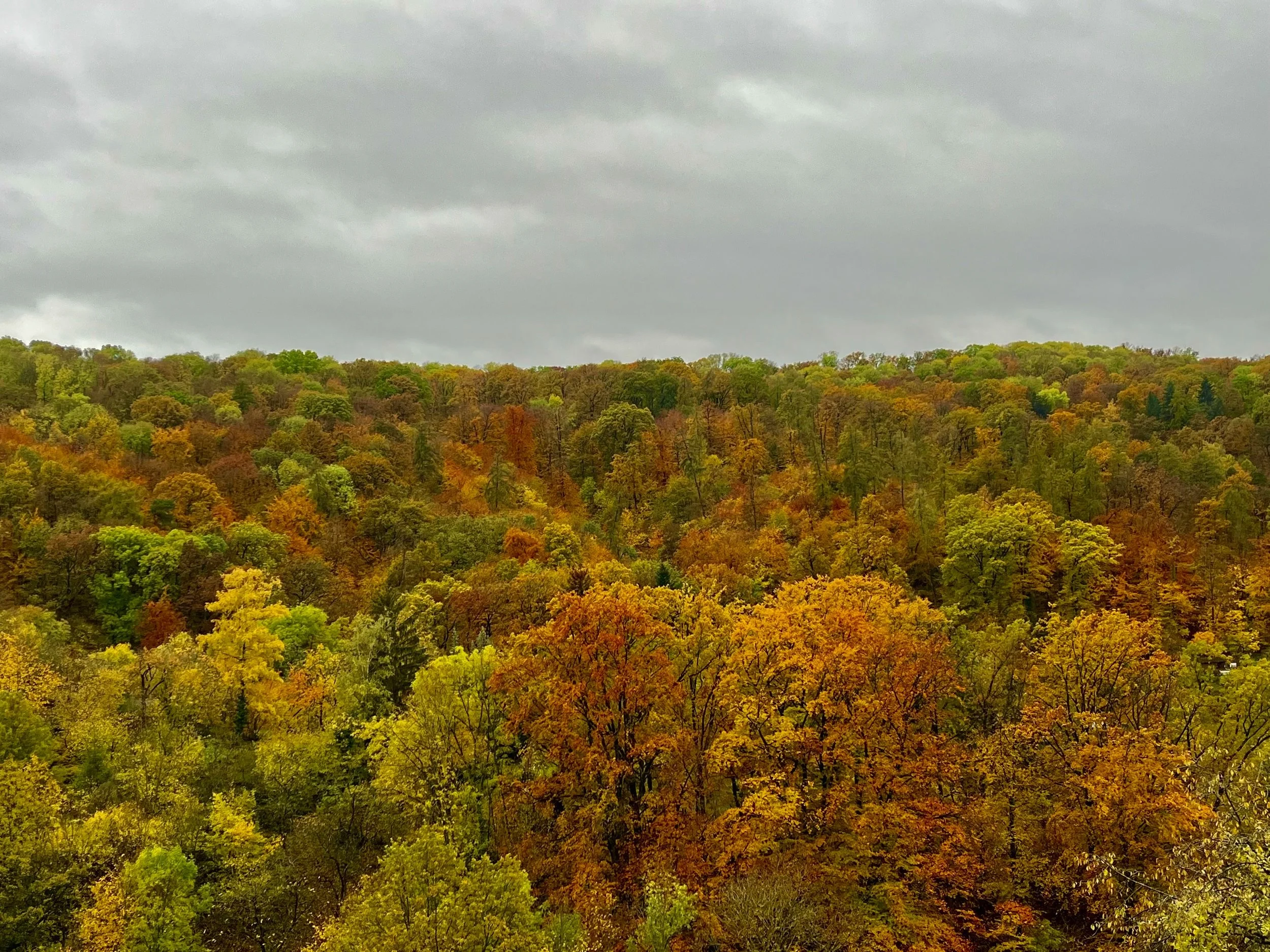
ON A WALK DURING FALL IN STUTTGART, GER, 2024
“The whole is greater than the sum of its parts.” - Aristotle
Lately, I’ve observed myself feeling out of place in groups that seem all the same—something I notice more often these days.
In those moments, I remind myself:
Nature thrives on diversity, not sameness.
This idea of our collective wholeness—how our differences create something bigger—helps me reframe my discomfort and feelings of isolation.
Instead of focusing on what sets me apart, I see how my unique experiences, alongside others’, weave a kaleidoscope of perspectives that’s far richer than the sum of our individual selves.
The former business executive Björn Lindeblad, who chose to live as a forest monk for 17 years, reminds us in I May Be Wrong that regardless of who we are, where we come from, and what our history is, we tend to have a lot in common in terms of our inner workings.
He encourages us that by admitting this and shining a light on it, we make it easier to stop pretending we’re on top of everything.
It feels like an encouraging realization:
Our diversity is an aspect of all of us generally functioning in similar ways, adding to our collective richness—multiplying it, creating something far more vibrant and complex than any single one of us could ever achieve alone.
In nature, diversity is everything.
Coral reefs—among the most diverse ecosystems—rely on every species to keep the entire system healthy and resilient.
Forests need trees, fungi, insects, and animals—each with a role. Lose one, and the whole system feels it. As Peter Wohlleben put it in The Hidden Life of Trees: “A tree can be only as strong as the forest that surrounds it.”
Beehives thrive because of the diversity of roles: workers, drones, and the queen. Each bee’s contribution matters.
Just as these systems thrive through their diversity, I’ve noticed that aiming for the greater good often brings out new strengths in us.
What if we consider:
When we embrace our differences and aim for the greater good, we become more resilient and innovative.
The Greek proverb says it well:
“A society grows great when old men plant trees whose shade they know they shall never sit in.”
Every one of us changes the equation, just as a single drop shifts the balance of a vast ocean—sometimes in ways we can’t yet see.
Our impact goes beyond our own time—just as the planted trees do. Our wholeness goes beyond the sum of our single contribution.
How the System is Woven Together
Throughout my circle of friends across the globe, certain topics always seem to come up at the same time, spreading through our interconnectedness.
Right now, we’re all digging deep into how to approach life with a mindset of consuming and producing less—something that’s been urgently emerging globally.
It’s as if our conversations branch out into our own corners of the world, spreading the vibe even further. Like when I recently talked with friends in Chicago and Tokyo—we hung up eager to put new ideas into action, each from our own continent.
This rhythm of topics becoming a priority reminds me of the words of Margaret J. Wheatley: “There is no power for change greater than a community discovering what it cares about.”
In this way it appears:
Embracing our oneness can help us break free from the limitations of our automated habits and the fear of not having enough.
This togetherness creates a rising tide that lifts everyone—like the African proverb says, “If you want to go fast, go alone. If you want to go far, go together.”
And just as a sangha—a Zen or Indian community—spreads wisdom and support, we each carry ideas forward, weaving them into the fabric of our interconnected lives.
The Power of Connecting Beyond Set Structure:
As a bit of a loner, embracing community doesn’t always come naturally to me. But I find inspiration in the Indian saying “Vasudhaiva Kutumbakam”—the whole world is one family.
Beyond loneliness that visits throughout longer patches of solitude , I’m discovering a deeper clarity:
What if we consider:
We are not alone at all, but part of something bigger—like an aspect of a symphony, sensed in glimpses, even if we can’t put it into words.
These connections show up in small, everyday moments—like when I’m making morning tea and my neighbor waves from the window across the courtyard, still in her pajamas.
Or when a friend texts me about our ongoing “stretched out life conversation ”—multiple open tabs, no beginning or end, just accompanying us as we go.
In my multistory apartment house, connection is woven into daily life—everyone picks up parcels and mail left at the main door, carrying them up the stairs as they go.
Sometimes, I open my apartment door to find an indoor plant and food with a note asking me to take care of both while a neighbor is away.
We help each other like an orchestra: a lawyer handles legal issues, while some of us translate German paperwork for the refugee on the first floor. Our house parties happen on the rooftop garden, thanks to the generosity of the owner on the top floor.
We have each other’s keys, supporting daily life and little breakdowns with spontaneous coffees so everyone can keep moving forward.
The Paradox of Feeling Connected While Feeling Free
It always hits me when I am riding public transport how we connect across social groups and backgrounds.
I remember an article proclaiming NYC public transport as a symbol of equality—although the price of the ticket surely means different things to everyone.
The other day, I found myself sitting beside a couple from Australia here in Stuttgart, asking for directions and sharing their explorations of the foreign country they were visiting. A dog put his head on my lap, with the owner making sure I was comfortable, as I joyfully petted his head.
Then there was the boy, chatting with his mom on a phone call, amusingly explaining that he didn’t want to go to soccer practice because—no matter what he did—he always got shouted at by the trainer.
He made a convincing case for why it didn’t really matter if he showed up or not, which got some chuckles from those of us who overheard his exasperated reasoning.
It gave me a sense of belonging, even as I was on my own, moving through the city and briefly connecting with others on the ride.
What if creating this sense of belonging is at times as simple as looking up from our screens on the subway?
What if we consider:
By clearing away the little barriers to connection, we open up space for new conversations, and start to feel that shared sense of belonging.
Is Our Experience More Communal Than we Think?
Rick Rubin, after decades of influential record producing, states that “The synergy of a group is as important- if not more important-than the talent of the individual.”
Turns out:
To contribute best to this wholeness of singular contributions, it pays to focus on ourselves—because elevating our own game lifts the whole.
When we’re true to ourselves, we find our best way to connect and contribute to the group—like an instrument that’s perfectly in tune, or, if you’re open to it, even in sync with the whole universe.
What if we consider:
We’re enhancing this vibrant tapestry of our shared human experience when we align with what resonates best with our true selves.
This way of looking at things doesn’t just make life more interesting—it can be a real game-changer in how we see ourselves and others.
Pema Chödrön explained in How We Live Is How We Die that by knowing ourselves, we come to know humanness altogether. She points out that “We are all up against these things. We are all in this together.”
It’s like we’re all bringing our own unique ingredients to this massive, ever-changing table of human experience. And it surely seems more exciting than if we all brought the same flavours.
So how are these flavours combined?
Being part of something greater means moving together as a team.
It’s about going beyond “me and them,” “us and the others,” “right and wrong,” and “black and white.”
It’s about embracing variety to create a symphony that is “greater than the sum of each contributing voice.”
It’s about my doctor friends joining forces with creatives, moms, coffee shop owners, and legal talents—language skills exchanged for home-cooked meals—and together, we all become stronger by merging our differences.
Turns out:
Diversity is about appreciating our differences while embracing our wholeness.
Joyfully, while I currently drive a battered-up 20-year-old car, a friend who works for a fancy car company lets me indulge in a fancy ride now and then.
We laugh about it because she’s bewildered by how much I enjoy that superficial power—while we climb mountains, barbecue in the garden, and keep up our ongoing discussion about living creatively with less.
The Challenging Aspects of Wholeness
In the corporate world, diversity and equality are hot topics—many companies now see the value in bringing together a variety of perspectives.
Employee branding aims to build a sense of belonging and unity, but it can be a double-edged sword: while feeling part of something bigger sparks enthusiasm, it can also tie you too tightly to work, leaving less room for the rest of life.
Sometimes, I wonder if the focus on diversity is really about inclusivity—or just about image and quotas.
A friend at a world-famous German car manufacturer was asked to create a video celebrating company diversity. Ironically, she had to recruit people from outside the company because the workforce wasn’t as diverse as the brand wanted to project.
Here’s the paradox:
We want to be inclusive and promote wholeness, but we also fear losing our edge in a culture that values competition over sharing and “enoughness.”
We often stick to what’s familiar, avoiding the discomfort of true diversity.
But research shows that diverse teams—with different backgrounds and perspectives—outperform in innovation, problem-solving, and even profits.
Diverse leadership turns out to drive new ideas and market adaptability.
Then there’s the tricky part: collective responsibility.
As the saying goes, “When no one is to blame, everyone is to blame.”
It’s easier to share blame when we’ve messed up individually than when it’s someone else’s fault.
This tension—between our desire for wholeness and our fear of shared accountability—makes genuine inclusivity a complex challenge.
What We Gain
I’ve been lucky to connect with people from all sorts of backgrounds, learning from our differences and finding creative inspiration in the unfamiliar in the several countries I’ve lived.
Besides initially coming together through design work, I’m constantly discovering new cuisines, cultural traditions, art, social cues, and ways to act—and simply be.
There are many amusing learning moments, like realizing your friend from Colombia is still in the shower while you’re already at the meeting point, thanks to your German sense of punctuality.
In my extended family—both blood relations and chosen connections—our diversity, combined with a sense of belonging and wholeness, makes for a lively melting pot of inspiration and literal color.
At one of our last gatherings, we delightfully noticed how we span almost the entire spectrum of human skin tones—from fair, freckled complexions to deep ebony.
This visual reminder of our differences enriches our shared experiences and creates a more vibrant, interesting, and harmonious whole.
Could it be a win-win to embrace our interconnectedness?
What if contributing best to our own wellbeing is synchronized with the well-being of our shared existence. As Helen Keller states:
“Alone we can do so little; together we can do so much.”
Just as ecosystems thrive on biodiversity, our lives and communities are enriched by a tapestry of experiences, perspectives, and identities.
By being true to ourselves and welcoming others’ uniqueness, we help create a more vibrant, resilient, and creative world.
We don’t just accommodate diversity—we celebrate it as the essence of our shared humanity and the key to collective growth and innovation.
Questions to reflect on:
How has embracing diversity enriched your life ?
When have you experienced the power of a group that felt greater than the sum of its parts?
What’s one way you can challenge your own biases or step outside your comfort zone this week?
How do you balance fitting in with being your authentic self?
What small, everyday interaction has reminded you that you’re part of something bigger?
How can we create spaces where everyone feels seen, heard, and valued for their unique contributions?
Does the unfamiliar make you feel uncomfortable—or eager to fit in? Why?