What if we Reframe Trial and Error?
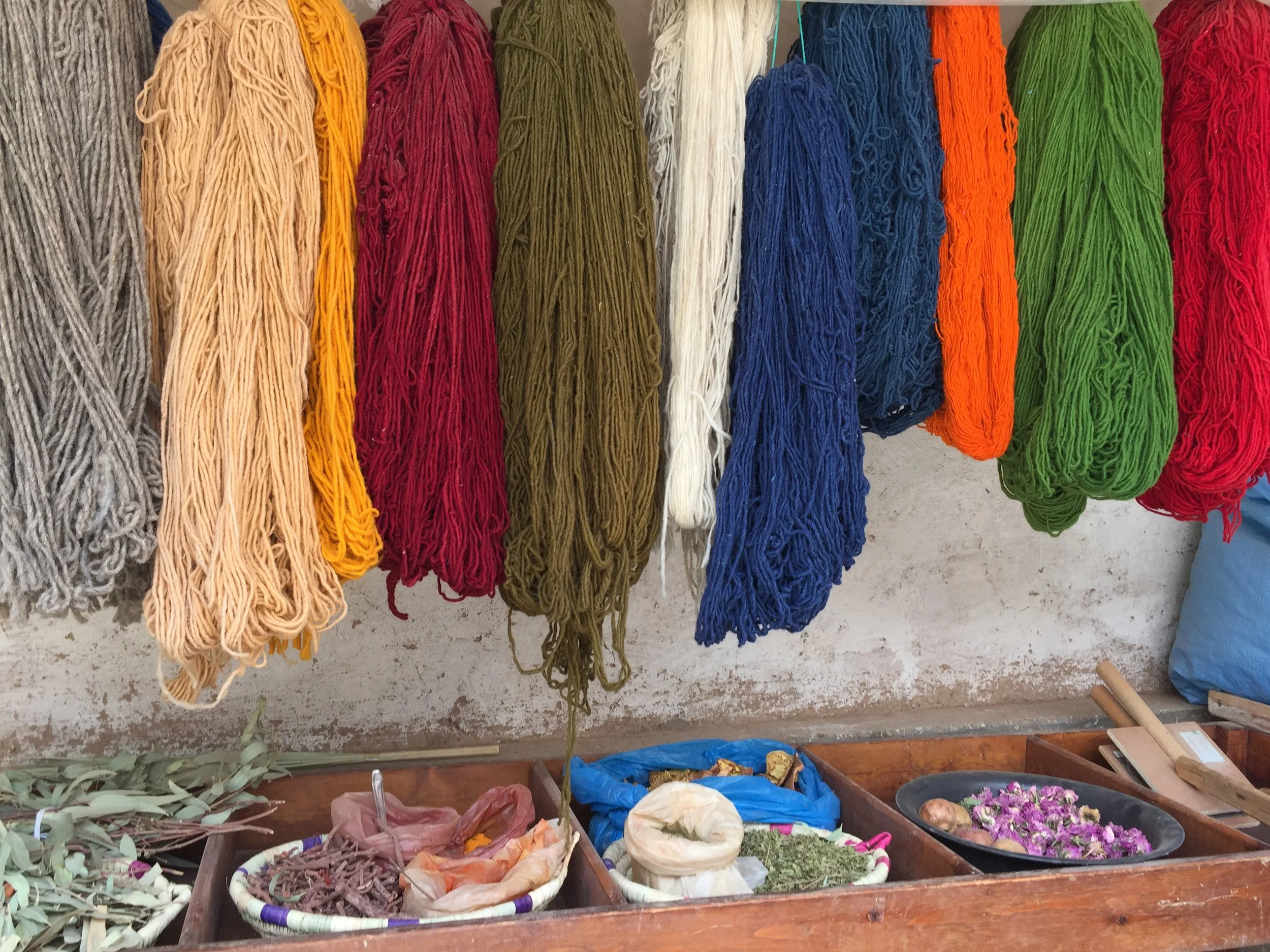
TRIALS FOR NATURAL COLORS, VISITING A CARPET MAKER IN THE ATLAS MOUNTAINS, MOROCCO
"Success is stumbling from failure to failure with no loss of enthusiasm.” - Winston Churchill
The other day I accidentally washed one of my favourite oversized wool sweaters in between washing other things that could bear more heat. It resulted in said sweater emerging from the washing machine at about half its original size.
After cringing at my oversight, I took a closer look. To my surprise, a few larger holes that had been annoying me had actually shrunk together-literally closing up.
The slightly felted effect gave the piece a look that was more modern than its original traditional cable pattern. I found myself falling in love with its unexpected second life. It got me thinking:
What if many so-called “errors” aren’t failures at all, but the very essence of our creative exploration and evolution?
Inspired by the “accident,” I set out to try a few more washing experiments to breathe new life into some sweaters that had stretched out of shape. What started as a genuine mistake quickly became my next creative project.
Admittedly, I’ve shrunk two sweaters down to dog-size along the way-one of them now fits a friend’s small terrier remarkably well. Yet the adventure of experimenting and giving something old a new look sparked a real joy of creative exploration.
It’s that feeling-our soul doing a little leap-when we stumble upon something unexpected. It inspires us to open our minds beyond what looks like a mishap.
We can embrace life as a scientific journey of constant discovery, where each stumble is a step towards growth.
This mindset was alive in a weaving factory we visited while traveling through Morocco, where artisans developed recipes for natural dyes. Trial and error wasn’t just encouraged-it was the way.
Each ingredient had a life of its own, making measuring a constant dance between new experiments and recalibration.
The Power of Serendipity: Accidents That Changed the World
There is well-known evidence that reframing “trial and error” as scientific exploration toward unplanned success isn’t just optimistic-it’s accurate.
Many mishaps we “chalk up to experience,” as the proverb goes, have actually sparked some of the world’s most life-changing breakthroughs:
Penicillin: Alexander Fleming accidentally left a petri dish of bacteria uncovered; mold killed the bacteria, leading to the discovery of the first antibiotic. This revolutionized medicine, saving millions of lives.
X-rays: Wilhelm Röntgen, while experimenting with cathode rays, noticed a fluorescent glow and discovered X-rays, transforming medical imaging and diagnostics.
Microwave Oven: Percy Spencer realized microwaves could cook food after a chocolate bar melted in his pocket while he worked on radar equipment, forever changing kitchens worldwide.
Post-it Notes: At 3M, Spencer Silver tried to make a strong adhesive but ended up with a weak, repositionable one-perfect for sticky notes, now a staple in offices everywhere.
As the successful record producer Rick Rubin noted on working in the creative field of recording with an open mindset: “You work not as an evangelist, expecting miracles, but as a scientist, testing and adjusting and testing again. Experimenting and building on the results.”
Too often, it’s a rushed final conclusion-or the fear of failure-that blocks our evolution.
Sometimes, we don’t even try, depriving ourselves of true innovation or the surprise of what might work in practice.
When Franklin D. Roosevelt was Governor of New York, he famously declared:
"The country needs and, unless I mistake its temper, the country demands bold persistent experimentation. It is common sense to take a method and try it: if it fails, admit it frankly and try another. But above all, try something."
This quote captures the spirit of action, innovation, and learning from both successes and failures.
In creative work-and in life-it’s about perseverance beyond doubt, insecurity, and vulnerability. It’s about taking the next step, rather than getting stuck on whether we’ve “failed.”
The journey might not take us where we expected, but it often leads somewhere beyond our wildest, most rationalized dreams.
Could Chaos and Doubt Be the Source of Your Next Creative Breakthrough?
When you feel you’ve truly lost the path-as if you’re in a state of chaos-you might actually be closer to a creative breakthrough than when everything seems to be sailing along smoothly. (Reminder: a known path is rarely the road to innovation, since it’s built on familiar parameters.)
The idea that “creation emerges from chaos” is backed by chaos theory and the concept of emergence, where new properties or structures arise from complex systems-sometimes unpredictably.
Consider this:
What if you saw trial and error as a process leading to an outcome more innovative than anything you know right now? What if it’s precisely what works out differently than expected that opens up a new path-like picking up a book you never planned to read, simply because what you wanted wasn’t available?
What if going through the motions of potentially failing didn’t feel so harsh, if you reframed it as taking the experimental path? For example, my admittedly fragile (my friends would say non-existent) sense of direction means I often end up in places I didn’t even know existed. The upside? I probably know my surroundings better than most, simply because I get lost so often.
What if substitution could be expansion? A friend recently “translated” a recipe from an American patisserie chef, swapping out ingredients she couldn’t find in Germany. The result? A brand-new cookie that’s now everyone’s favorite-born from experimenting with the original instructions.
Adam Grant writes in “Originals” about “creative destruction”-remaking or rethinking conventional ideas from a new perspective. He argues that originality often means rejecting defaults (like the original recipe) and exploring better options.
What if things falling apart are actually the ashes a phoenix will rise from?
What if doubt isn’t as bad as its reputation? What if doubt is a kind of endurance training, making us stronger as we learn not to judge too soon?
What if doubt is even precious-a tool that peels away the layers keeping us from going deeper?
As Krishnamurti pointed out, doubt “cleanses, purifies the mind. The very questioning, the fact that the seed of doubt is in one, helps to clarify our investigation.”
Figuring it Out in Action
Born with a strong hip displacement, I spent my first six months in solid plaster and the next two years in special orthoses-an experience that seriously interfered with the natural progression from crawling to walking.
The doctors’ advice at the time? Let me figure out how to walk on my own, adapting around the surgical appliance as best I could.
The gist was simple: the less external interference, the more natural and aligned with the toddler’s own capacities the solutions would be.
Time and again, action beats theory-feeling what works is far more effective than learning about it in the abstract.
Touching a hot surface teaches a child to back off much faster than any conceptual warning ever could. That’s the power of direct experience: it’s immediate, memorable, and intuitive.
This is the principle behind intuitive design: users should be able to understand and use something naturally, without needing step-by-step instructions.
Steve Jobs championed this philosophy, insisting that products should be “intuitively obvious” and so simple that people can skip the manual and dive right in-learning by doing and feeling what works.
His approach set a new standard for user experience, emphasizing that great design is not just about how something looks, but how it works and feels for the person using it.
Simplicity and user-first thinking can make things so clear and self-evident that trial and error feels playful, not frustrating.
User-first, I navigated my hip-displacement device-figuring out my own moves, often interrupted by a fall, a twist, a high-pitched scream, or an excited giggle as I wiggled my way through the “obstacle course.”
As was often observed, I rarely tried the same thing twice if it didn’t produce an upgrade.
Encouraged by my ever-experimental, creative-artist parents, I worked through those challenges playfully and eventually became an avid hiker and walker, ran a marathon, and grew up horseback riding and ski racing on strong legs.
As Thomas Edison, legendary for his inventions and experiments, is often credited with saying:
"I have not failed. I've just found 10,000 ways that won't work.
Maximising the Power of Experimentation
Nassim Nicholas Taleb, in The Impact of the Highly Improbable, reminds us that “the strategy for the discoverers and entrepreneurs is to rely less on top-down planning and focus on maximum tinkering and recognizing opportunities when they present themselves.”
This core argument-maximize experimentation to increase your chances of encountering rare, high-impact “Black Swan” events-has become a touchstone for innovators.
Building confidence in our own judgment through the results of our explorations is one of the most impactful ways to form our own reliable truth.
In design, some of our most commercially successful outcomes came from making “trial and error” prototypes-testing one shape in different fabrics, for example. The results spoke for themselves: it was immediately clear what worked best.
Key benefits of learning through trial and error go beyond just finding solutions:
Encourages innovation and creativity by pushing us to try unconventional approaches and discover solutions that aren’t obvious from existing knowledge.
Promotes adaptability and resilience, as each failed attempt teaches us something new and helps us refine our strategies.
Broadens our perspective, often revealing “unknown unknowns” and “Black Swan” events-outcomes we couldn’t have predicted or planned for.
Fosters self-discovery and authentic understanding, since figuring things out ourselves leads to deeper, lived knowledge.
Taps into innate human curiosity and the drive to explore, experiment, and play-essential for radical creativity and breakthrough thinking.
Builds critical problem-solving skills and confidence, empowering us to tackle new challenges independently and flexibly.
Minimizes risk by allowing small-scale experiments before committing to big decisions-fail fast, learn fast, and avoid large-scale mistakes.
Cultivates a mindset of continuous learning, where every outcome is valuable feedback that sharpens our intuition and skill.
But let’s be real-trial and error isn’t just a playground for creative breakthroughs. There’s always a bit of risk in the mix.
Sometimes it’s emotional: the sting of failure, a bruised ego, or the uncertainty of venturing into the unknown. Putting yourself out there, trying something new, and possibly falling flat on your face-that takes guts.
It’s easy to feel exposed or even a little foolish. Yet, as Nelson Mandela famously said: "Do not judge me by my successes, judge me by how many times I fell down and got back up again"
And yes, sometimes there’s a practical side to the risk, too. Maybe it’s a financial investment, time you can’t get back, or resources that don’t magically replenish themselves.
But here’s the thing:
Trial and error isn’t about gambling away your savings or tossing caution to the wind. It’s about experimenting with intention-taking smart, measured steps, learning as you go, and knowing when to pivot.
The magic happens when you balance curiosity with a healthy respect for your own limits.
You don’t need to risk it all to learn something new. Instead, you’re giving yourself permission to explore, to play, and to grow-without letting fear or recklessness run the show. That’s where the real empowerment kicks in.
Ultimately:
We advance by defying the default settings-by questioning what’s considered the “reasonable” choice.
Progress and innovation often come from those who challenge the status quo, rather than those who simply accept things as they are.
Give It a Try-In the Simplest Ways
Swap out an ingredient in a dish you always make and see how it changes the experience.
Take a different path than usual and discover how your neighborhood is interconnected.
Wear a color you never wear and notice how it makes you feel. Maybe you’ll get an unexpected compliment and realize how inner and outer perceptions can differ. (Little reminder: How it feels to you is more important than how it looks to others.)
So, can we reframe trial and error?
Absolutely. When we view our “errors” not as failures, but as essential steps in our journey of growth and discovery, we transform how we approach challenges and innovation in our lives.
If we succeed, we set up a new status quo to be challenged. If we “fail,” we’ve advanced our learning.
This reframing lets us embrace the process of learning and growing, instead of fixating solely on outcomes.
To close with Churchill:
“Success is not final, failure is not fatal: it is the courage to continue that counts.”
A few questions to ponder:
Are you comfortable with trial and error as a concept?
Do you see failure as something final?
What have you learned most from?
Can you recall a specific instance where a failure led to an unexpected success or valuable lesson?
What holds you back from trying something new?
How do you define success in your own life? Does it align more with achieving goals, or with the journey of learning and growing?