Are We Ever Meant to Arrive?
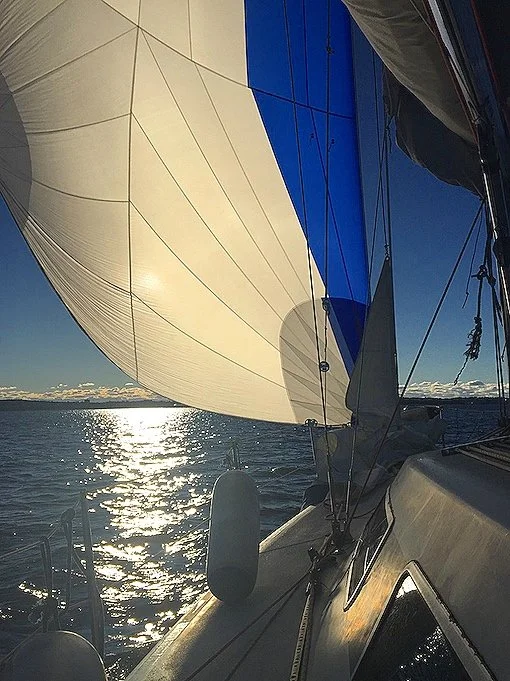
SAILING OUT TO THE NORTH SEA FROM STAVANGER, NORWAY, 2020
“Everything that is life and movement, that stirs up the soul, is a little bit of happiness.” - Arthur Schnitzler
The other day, a friend who had reached his lifelong goal of paying off a house worth several million told me he felt surprisingly let down by the effect.
He described it as feeling like a balloon with the air let out—all the motivation that brought him there simply evaporated.
I actually felt something similar after completing my first marathon—plummeting into an unenthusiastic state, wondering why I should carry on running at all. It made me question:
To what degree is reaching a goal motivating, and to what degree is the journey itself more impactful than the achievement?
What if the anticipation of a goal is more powerful than actually achieving it?
What if reaching a desired destination has a lingering undertone of “now what?
What if this is the reason many highly successful people according to the old powerparadigm of fame, power, and wealth can´t stop, even though they have more than enough?
How much is enough?
What if this is the reason so many famous people in the entertainment or sports world seem to spiral into helpless disorientation when the “ends have been met” and there’s nothing left to win or prove? They’re left wondering, “Where do I go from here?
Consider this:
While destinations can provide motivation and structure, they support our long-term joy far more when we see them as milestones, not endpoints.
What If the Summit Isn’t the Arrival Point?
Hiking provides a great example here, because the peak isn’t the point. It’s tempting to see the summit as the ultimate goal, but reaching the top is only ever halfway there.
It’s widely recognized that most accidents happen on the way down—when the adrenaline fades, focus slips, and fatigue sets in. The real challenge isn’t just conquering the peak, but navigating the entire path with presence and care, both up and down.
In hiking, as in life, you could say: The climb up is about striving and ambition. The descent is about integrating what you’ve learned—returning to where you started, but not as the same person who laced up their boots.
In hiking, our sense of true success is often challenged when weather or your own limits force you to turn back before reaching the declared summit.
The wisdom in any journey is in knowing when to push forward and when to honor your limit.
Pacing for Inspiration
When I get stuck while writing, I often walk around my apartment. It’s as if the movement helps me shake off mental stiffness and releases new energy. I take deeper breaths than when I’m sitting, shake out the stiffness in my legs and fingers from typing, and usually the stream of inspiration and thought picks up again.
It feels like something between traditional walking meditation—where you slowly walk back and forth with deep attention—and restless pacing. There’s a mindful quality, but also a hint of agitation that keeps me moving.
When I do my loops, I notice things I usually overlook because they’re so familiar—like the photos on my wall or book titles gathering dust.
It shifts the energy, as if I’m reminded to stay curious, to keep up my momentum—to leave behind the moment I was just stuck in, because there’s still so much to explore.
Maintaining Momentum
My dad once made a comment that has stuck with me ever since:
“You should wonder until the last day of your life.”
After arriving in Germany from the East Coast of the United States 60 years ago on a scholarship to attend a Masterclass, he ventured into a new life of uncharted territory—a time when taking that kind of leap meant rare, expensive phone calls and cutting ties with an old life in a way that’s almost unimaginable today, given our limitless hyper-connectivity.
Seizing the opportunity, he has remained in Europe ever since, navigating his days with the ongoing routine of a musician, following the call of his soul—always exploring, never arriving.
He never tires of exploring the world of music, whether alone or with his piano students, or while collaborating with and listening to other artists.
A lifelong avid walker, he still enjoys uncovering the intricacies of his neighborhood as much as he once discovered new countries and cultures throughout his long life.
I find myself wondering if his mindset—living life as an ongoing inquiry—is why he recovered from weeks in an induced coma due to multi-organ failure at 84, despite the prognosis that he likely wouldn’t return to this earth at all.
His resilience reminds me of the words of Einstein: “The important thing is to not stop questioning. Curiosity has its own reason for existing.”
These words makes me wonder:
What if vibrant energy is not found in arriving at a desired destination in life, but rather in the ongoing journey of exploring ourselves and the way we relate to the world?
It’s through consistently practicing that we stay fit. It’s by running or cycling regularly that we maintain endurance—not by training like crazy and then “settling” into a fit state.
It’s by reading, and questioning what we read and regard as solid knowledge, that we keep our minds sharp.
It’s by communicating ongoingly in our relationships that we keep evolving them, rather than striving for a “happily ever after” that might actually put the process on hold.
A violin that isn’t regularly played and maintained goes out of tune fast.
And while we live in a frenzy of maintaining youth, “longevity,” and with plastic surgery becoming mainstream, I wonder if this desire to solidify a state that is meant to be constantly in motion actually puts us in a freeze-state—less vital than a relaxed expression that isn’t so ironed out.
Maybe, at times, the more efficient use of your silverware is not to keep it in a cupboard to “safeguard” it—having to clean it on the rare occasions it gets used—but to use it, keeping it shiny by being in action, even if that means risking a few marks.
After all, what’s the use of never using it at all?
There are famous examples of explorers putting the process over the outcome:
Leonardo da Vinci: Famous for his insatiable curiosity and for leaving many works unfinished—including The Adoration of the Magi—he constantly jumped between painting, engineering, anatomy, and invention. His process embodied the spirit of endless exploration rather than finality.
Michelangelo: Known for his ongoing inquiry and refusal to settle, he even returned commissions when his interests shifted.
Louis Pasteur: Renowned for his groundbreaking work in microbiology—developing vaccines, inventing pasteurization, and revolutionizing science—he was always pushing into new territory.
Ferdinand Magellan: Set out to circumnavigate the globe, but never completed the voyage himself; his crew finished the journey after his death. Magellan’s legacy is about daring to venture into the unknown, not about personal arrival.
Each of these figures is remembered not for settling or “arriving,” but for their restless drive to explore, invent, and question.
What Is the Use?
A student of the Zen master Shunryu Suzuki, author of Zen Mind, Beginner’s Mind, once got discouraged because the higher states he experienced always seemed to pass. He asked, “What’s the use?” Suzuki Roshi laughed and replied, “That’s right, no use. All these states come and go, but if you continue your practice, you find there’s something underneath.”
Maybe that “underneath” is what we’re really after, but can’t define as a set goal.
My parents, being musicians, often express their puzzlement at the concept of living to retire someday, questioning what exactly one would retire to.
The way my dad practices piano daily, still enthusiastically teaching students at his advanced age, has inspired me. I keep practicing—resting and recharging so I can continue exploring—instead of waiting to finally “arrive” before I start living—a mindset that’s more common than we like to admit.
What if we question the set standards of society as we’ve internalised them?
What if our joy is often found in what seems incomprehensible to others?
Give yourself full credit: Sometimes we find ourselves proud of situations nobody else can relate to. For an elderly person, reaching the supermarket and making it back home might be a greater achievement than running ten miles is for someone half their age.
What we Lose When We Focus on Arriving
The Norwegian explorer, publisher, lawyer, and art collector Erling Kagge writes in Walking that we are born explorers, noting that exploration is not something we start doing, but something we gradually stop doing.
In an interview about his record-setting expeditions, he emphasized the importance of exploration in life, pointing out that the spirit of exploration is something we all have to a certain degree: “Being an explorer is not something you begin being, but something you slowly stop being.” He highlighted that we have it until we die.
As children, we often venture out, excited to explore new paths, unconcerned about the consequences. Ideally, we return to base camp—our parents or caregivers—to rest, recharge, and gather the courage to venture out anew.
However, as adults:
We often find ourselves entangled in the pursuit of certainty, seeking to alleviate the conflicting emotions that come with exploring the unknown beyond our comfort zone.
And while trying to evade discomfort is understandable, I also wonder to what degree our quest for predictability and security dulls our adventurous spirit—and what that means for our innate “human setting” as creative beings.
Where Will Maintaining Momentum Take Us?
The poet Rumi reminds us: “Keep walking, though there’s no place to get to. Don’t try to see through the distances. That’s not for human beings. Move within, but don’t move the way fear makes you move.”
His words point us toward moving from a state of curiosity and love, rather than fear. They invite us to seek the joy of exploration, not simply to run away from discomfort. They remind us that there is not a specific place to arrive at, but rather an inner journey reflected in our outer experiences.
And to relax the ambitiousness in us, Alice in Wonderland offers this: “If you don’t know where you’re going, any road can take you there.”
Her willingness to go down the famous rabbit hole can inspire us to embrace unpredictability, the unknown, and change as essential parts of the journey—which, really, is what life is largely about.
As Alice’s adventures are accompanied by the fellow travelers she meets along the way, it makes me ponder that familiar question:
Is life about the journey or the destination?
I´ve found myself pondering:
Life might be mostly about the people we share the different stretches of the journey with.
Similarly, when hiking, the camaraderie built with others on the trail often outlasts the memory of the summit itself.
What Keeps Us Moving Forward?
As much as the company and the process of the journey are impactful aspects of our lives, it does appear that the desire to arrive is an energy we move forward with—“keeping us on our toes,” as the saying goes, and helping us maintain momentum again and again.
It’s ultimately a dance between setting goals as guidelines and milestones, and focusing on the moment we are in.
That’s how we best maintain our health, sanity, relationships, fitness, and adventurous spirit—basically, cultivating the capacity to keep going by simply keeping on going.
By embracing our innate adventurous spirit—curiosity, creativity, love, peace, connection, and openness to the unexpected—we can reignite that spirit of exploration. This is the path of living fully, revealing a richness and vibrancy we are wired to experience, beyond arrival.
Have you asked yourself:
What would happen if you stopped measuring progress by milestones and started measuring it by moments of joy or learning?
Who are the “fellow travelers” on your journey, and how do they shape your path?
When was the last time you let yourself get lost—literally or metaphorically—and what did you discover?
If you could release the pressure to “arrive,” what might you try, create, or explore next?
Are you striving for certainty, or can you embrace the unknown?
What fears are holding you back from exploring new paths?
How does your relationship with uncertainty shape your sense of adventure?