Are We Counting on the Limitless Opportunities of the Unknown?
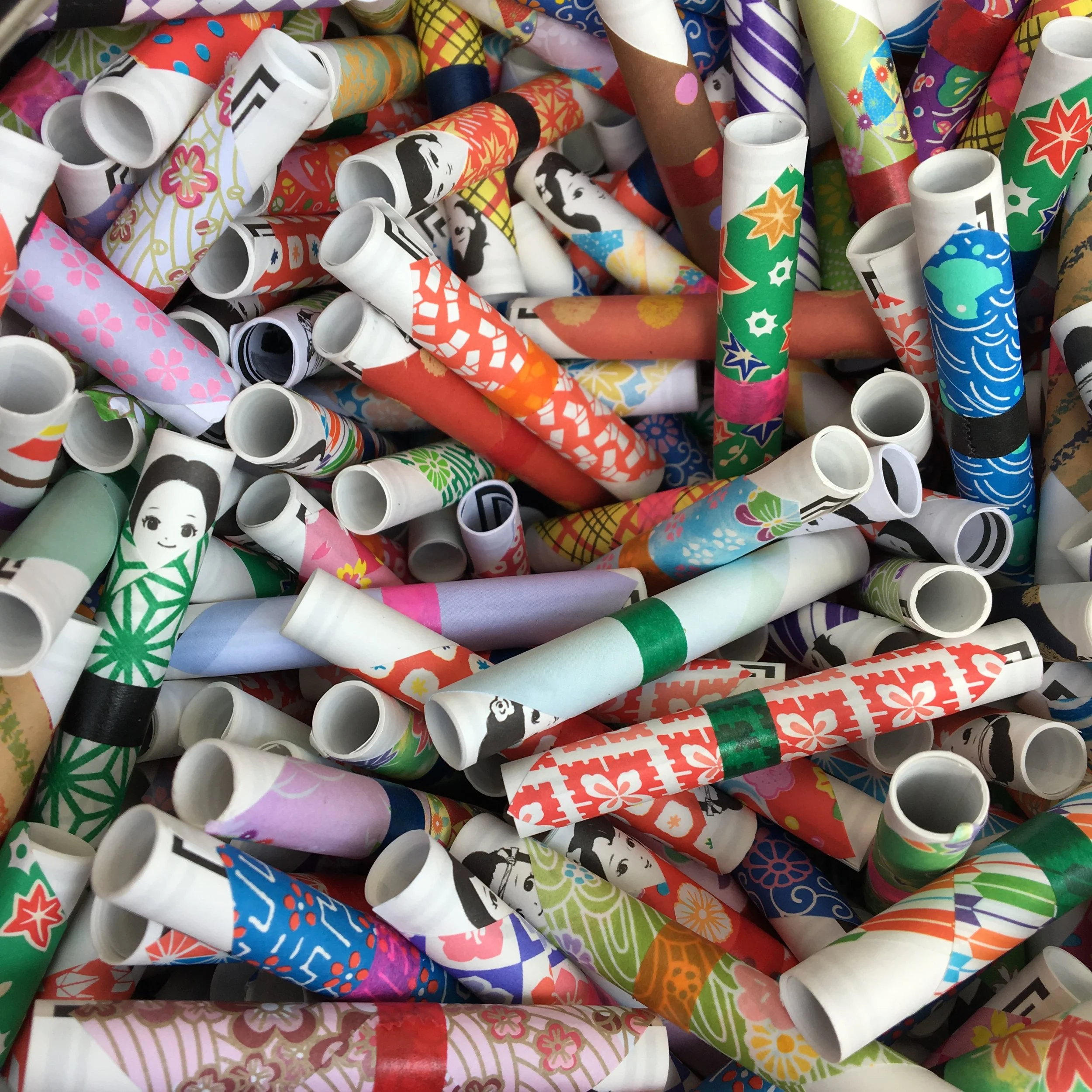
OMIKUJI: UNKNOWN OPPORTUNITIES HELD IN JAPANESE FORTUNE TELLING IN KYOTO, JP
With watery eyes, a friend admitted the other day that too many unpredictable occurrences are making her feel she’s losing control lately. As a parent unexpectedly needs care, a new boss rattles the status quo, and her landlord claims her apartment for himself, she lies awake at night with her mind spinning.
Frantically trying to predict what will happen next, she feels as if she’s constantly holding her breath. Just listening to her, I noticed my own breath getting shallow, forgetting to fully exhale as her anxiety practically vibrated in the air. It made me wonder:
What happens when we shift our energy towards being alertly prepared for the unknown, rather than exhausting ourselves by trying to predict what will happen next?
Alan Watts stated so vividly in The Wisdom of Insecurity that our desire for security and the feeling of insecurity amount to the same thing.
He points out that by holding our breath we lose our breath, as “A society based on the quest for security is nothing but a breath-retention contest in which everyone is as taut as a drum and as purple as a beet.
He argues that our relentless pursuit of certainty and safety actually makes us tense, anxious, and—ironically—even more insecure. Turning “blue in the face” from the strain of trying to hold onto security—like holding our breath until we’re about to burst.
What if resisting change—when change is the very nature of life—is what actually makes us more rigid and inflexible (and stiff in the neck), rather than providing security?
What if the more we try to predict what happens next, the more anxious we get? What if insisting on things being a certain way is what makes us feel more divided and isolated from the natural flow of life? It seems:
The more we try to lock down certainty, the more we end up stressed out and cut off from the flow of life.
What if living with more ease is dependent on us embracing unpredictability?
What if that tight, restricted feeling in our chest, the chronic tension in our muscles, the jumpiness, and our inability to focus for more than a few seconds are all symptoms of a vicious cycle—a Gordian knot that only tightens the more we resist the unknown?
But What If We Look At Things From The Opposite Angle?
Henry Ford encourages us, “When everything seems to be going against you, remember that the airplane takes off against the wind, not with it.”
Maybe it’s time to view our challenges from a completely different perspective than we’ve used so far.
What if being frantically tied up in predictions is the real issue?
Back to the Gordian knot: it was a legendary tangle of rope so complex and tightly wound that it was said to be impossible to unravel. Undoing it would have meant patiently picking apart every twist and turn.
But as the story goes, Alexander the Great didn’t waste hours fiddling with the knot—he sliced right through it with his sword.
Here’s where the metaphor flips:
What if our “sword” isn’t brute force or control, but the simple act of being prepared—keeping our blade of awareness sharp at all times?
Instead of exhausting ourselves trying to untangle every possible outcome, we cut through the cycle by accepting that life is unpredictable.
We invest in adaptability and presence, not in rigid plans or the illusion of solidity.
In other words:
Instead of tightening our grip on certainty, we cultivate the flexibility and resilience to meet whatever comes—breathing through the unknown, rather than choking on it.
So maybe the most impactful way to “cut the knot” of modern stress is to stop fighting for predictability, and start training ourselves to move with the unknown—one deep breath, one present moment at a time.
Why Is It So Hard to Let Answers Unfold Naturally?
In my years in corporate settings, where the pressure for immediate, definitive answers runs high, I often watched in disbelief as people preferred a confidently stated answer—even if it was wrong—over simply admitting uncertainty.
In these environments, which thrive on meticulous PowerPoint presentations and bulletproof predictions, not delivering a solid answer was seen as a weakness. The discomfort of sitting with ambiguity was often bulldozed by a quick, stereotyped reply.
Oliver Burkeman, known for his sharp takes on time management and happiness, points out our collective unease with letting reality unfold at its own pace.
He mentions that when we’re faced with a challenge, “it feels better to race toward a resolution—any resolution, really, so long as we can tell ourselves we’re dealing with the situation, thereby maintaining the feeling of being in control.”
I’ve experienced that urge firsthand—the need for an answer, any answer, just to avoid admitting I didn’t have one yet. It made me realize:
In a world that craves certainty and quick fixes, embracing challenges with measured preparedness can feel almost rebellious.
Getting Ourselves Stuck in Constant Acceleration
In the daily rush, we rarely slow down enough to actually feel our way through challenges or make considered moves.
Afraid of “wasting” even a second, we dig ourselves deeper into the groove of declaring a conclusion before we’ve truly reached one.
Here’s the catch: the more we accelerate, the tighter we make our own Gordian knot:
By charging ahead on habitual autopilot, we just get more stuck—defaulting to old settings that don’t produce anything new or creative.
Sure, this strategy keeps discomfort at arm’s length. We confuse busyness with efficiency. But in the process, we block original possibilities from ever surfacing.
It’s a classic modern move: living right past the moment we’re actually in, exhausting ourselves by trying to predict the next wave—instead of learning to surf the waves of uncertainty as they come.
What Makes It Challenging Is Also Our Chance
There’s no denying it: facing the unknown comes with real challenges.
Uncertainty is unsettling. It complicates decision-making and long-term planning. Conditioned to fear mistakes, we start seeing the unknown as a threat to avoid at all costs. Living with ambiguity is uncomfortable—maybe one of the toughest skills to lean into.
Sometimes, it feels like a Herculean effort just to hold the paradox of uncertain feelings, especially when we’re pushed beyond the comfort zone of what we know.
It’s not just the fast-paced work environments that pressure us for instant answers—life itself is accelerating, especially with AI and tech pushing for snap decisions before we’re “overtaken.”
The hardest part? Resisting the pressure from others who crave predictability and want us to fit their expectations. That’s often when we cave, chasing the security of acceptance.
But what if we could learn to prepare for what we can’t predict?
What if our struggle is also our shot at something greater, as M. Scott Peck suggests in The Road Less Traveled?
He argues that our finest moments often come when we’re deeply uncomfortable, unhappy, or unfulfilled. “For it is only in such moments, propelled by our discomfort, that we are likely to step out of our ruts and start searching for different ways or truer answers.”
Turns out, whether in creative work or life in general, the ability to navigate ambiguity and stay open to multiple possibilities is the secret ingredient for innovation, personal growth, and effective problem-solving—again and again.
The Power of Living in a State of Alert Preparedness
In The Black Swan, Nassim Nicholas Taleb introduces the idea of “unknown unknowns”—those things we don’t even realize we don’t know.
Taleb, a Lebanese-American essayist and risk analyst famous for his work on randomness and uncertainty, made me rethink the limitless possibilities we overlook every time we take the bait and stick with the familiar.
He quotes friends from the U.S. Department of Defense who advise:
“Invest in preparedness, not in prediction.”
Taleb’s focus on preparedness over prediction is right in line with a scientific mindset. Both approaches value being open to the unexpected and willing to adapt as new information comes in.
Just as scientists are ready to revise their hypotheses when fresh data appears, Taleb suggests we should be ready for unforeseen events—rather than clinging to a single expected outcome.
When we step outside the comfort zone of what we already know, we throw open the door to new ideas and creative solutions.
It’s not about tossing caution to the wind, but about realizing that our mindset can be our biggest limitation.
Every time we ignore what we don’t know, we’re also ignoring the immeasurable wealth of possibility that lies just beyond the edge of our current knowledge.
What if the Unknown Is Our Source of Limitless Opportunity?
By reframing the unknown as an opportunity instead of a threat, we cultivate a mindset of alert preparedness. Ironically, this state of readiness is the most reliable source of security in a world defined by constant change.
What do we gain from a state of alert preparedness?
Increased adaptability: We build resilience and flexibility, rolling with life’s inevitable changes instead of resisting them.
Improved problem-solving: We strengthen our critical thinking and become better at finding effective solutions—even when the path isn’t obvious.
Enhanced creativity and innovation: Thinking outside the box becomes second nature, opening doors to ideas and solutions beyond what we already know.
Greater openness to new experiences: We get braver about exploring new opportunities and perspectives, instead of sticking to the same old script.
Reduced stress from control: We drop the pressure to have all the answers and learn to trust ourselves to meet each moment as it comes.
So, what does preparedness actually look like in practice?
Think through a challenge, then set it aside. Work with what you know, then let your subconscious mull it over. Often, new insights or unexpected info will bubble up when you least expect it.
Flip your perspective. Argue the opposite side, or have a friend play devil’s advocate. Blind spots and new angles tend to show up when you shake up your viewpoint.
Practice delayed decision-making. Give yourself permission not to have the answer right away. Set a time to revisit the issue after a break or a few days—you’ll be surprised what clarity can show up.
Journal it out. Let your thoughts roam without pressure to resolve everything instantly. Sometimes your best ideas sneak up on you when you’re not looking.
Engage in mindfulness. Stay alert, not frantic. Respond from clarity, not knee-jerk reaction.
Reflect on past wins with uncertainty. Remember times you handled the unpredictable well. That confidence is gold when you’re facing the next unknown.
Adam Grant offers valuable insights on embracing uncertainty and maintaining a growth mindset in Think Again: The Power of Knowing What You Don't Know.
He points out that, as a scientist by trade, you’re “paid to be constantly aware of the limits of your understanding. You’re expected to question what you know, be curious about what you don’t know, and update your views based on new data.”
This approach isn’t just for scientists—it’s a way to meet all of life’s moments creatively, with curiosity and alert preparedness.
A scientific mindset is a lot like a creative mindset: both see uncertainty not as a threat, but as a springboard for new ideas.
As Grant puts it, “The curse of knowledge is that it closes our minds to what we don’t know.”
It’s by staying open to our own blind spots—and being willing to prove ourselves wrong—that we grow the most.
Of course, there are times when quick decisions are non-negotiable—like swerving to avoid an accident on the road, responding to a child who’s about to touch something hot, or acting fast in a medical emergency.
But when it comes to the creative management of everyday life, it pays to get comfortable with discomfort—to meet each moment with the sharpness of the sword of alert preparedness, ready for whatever arises.
Experiment with The Unknown:
Family curveball? If relatives announce a surprise visit, relax and order takeout instead of stressing about whipping up a picture-perfect dinner.
Travel hiccup? If you forget to pack something and only realize it at your destination, see it as a chance to discover something new for your wardrobe instead of fussing over finding a replacement.
Closed restaurant? If your go-to spot is shut, try the neighboring place instead of hunting for something exactly the same.
Reflect On This:
Where in your life are you holding your breath, waiting for certainty?
What’s one area where you could experiment with alert preparedness instead of prediction?
How might embracing the unknown open up new possibilities for you?
When’s the last time not knowing led to a creative or unexpected outcome?
In what situations do you feel most tempted to rush to an answer? What happens if you pause instead?
Can you shift your perspective to see the unknown as an opportunity, not just a challenge?