What if There is Potential in Boredom?
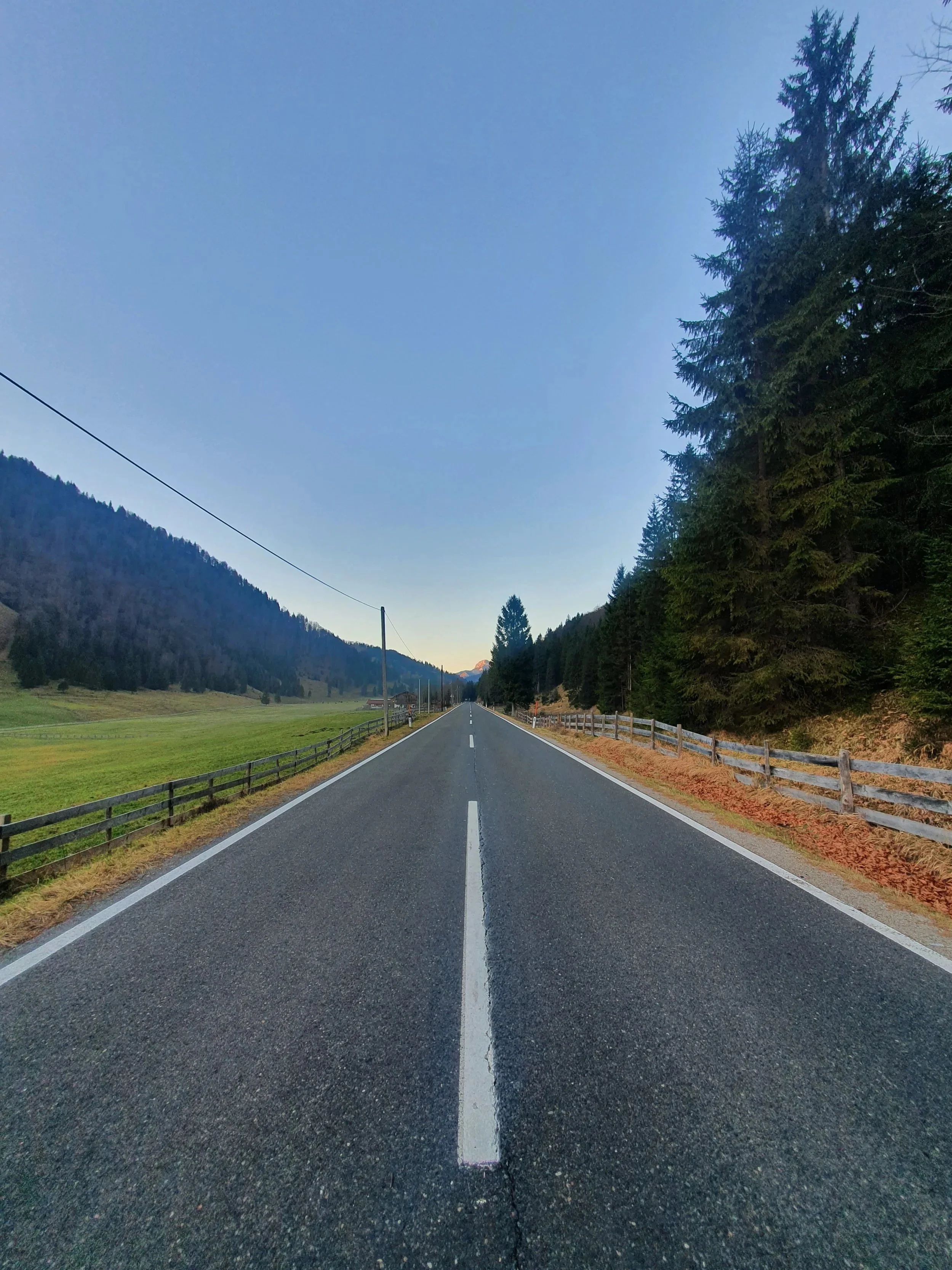
RETURNING FROM A HIKE; “GOLDEN HOUR” ON THE HORIZON; AUSTRIA
In a consumer-driven society where the chase for the next high and instant gratification is the norm, I’ve started to wonder about our innate fear of being bored, even for a moment.
Why do we take out our phone every time we stand in a line?
Why is everyone hunched over on the train instead of gazing out the window?
What is it that seems so threatening about boredom?
Why is it something we try to avoid, and what are we losing by doing so?
Boredom can be generally described a temporary feeling that pops up when we lack external stimulation or just don't feel motivated. Ironically, the more we have to distract ourselves, the more boredom becomes a dread.
But what if that “daunting” feeling is actually a signal?
What if it's not something to be avoided, but a doorway to something else entirely?
What if Boredom Can Spark Hidden Gems?
Growing up, whenever I complained about being bored, my parents would calmly say it was okay. Seeing my disappointed look, since they weren’t offering a solution, they'd just tell me to hang in there – “The next creative idea will come.”
I guess it's what I was encouraged to realize when my complaints about being bored were met with little attempt to "fix" them. It's how I came to the simple conclusion, that there is always something to explore - even if it is just whatever my mind was spinning on. And and what do you know, the boredom passed. Every time.
These days, being bored is one challenge I rarely have to deal with.
Maybe it's lucky if our initial complaints of being bored are met with subtle resistance to quench the itch.
Maybe we are losing more than we are gaining by avoiding this itch at all costs.
What if boredom can be a powerful state to create from?
While I didn't intellectually understand what my parents meant at the time, I guess I just carried on being bored a little bit longer - until I simply wasn't anymore.
As I was constantly crafting something or cooking up a performance my patient parents had to watch eventually, something always seemed to emerge from that emotional state I initially wanted to run from. It was almost as if I forgot to be bored as I realized that nobody was coming to save me.
What if not being rescued from boredom is a powerful way to learn we can indeed save ourselves?
It was as if by forgetting to feel sorry for myself I lost interest in being bored. And that alchemized into the next idea. Maybe there is a powerful truth to Walter Benjamin's words that "Boredom is the dream bird that hatches the egg of experience.”
In a way, boredom propelled me to make up something from nothing again and again. It made me throw tea parties with all my stuffed animals while lending each one a personality and voice. I invented plays, created invisible friends and fantasy worlds, while drawing, making music, writing, and using whatever was around.
In a way boredom gave me a chance to find a gap to connect with my inner creative nature. A gap to listen in beyond external “solutions” and see what's available right where I was.
Where Can Boredom Take Us?
What´s interesting is that while not knowing what to do, doing something that is monotonously repetitive, while seeming rather pointless can evoke a similar state.
Dr. Sandi Mann, a senior psychology lecturer at the University of Central Lancashire, conducted a series of experiments to explore the relationship between boredom and creativity.
In one study, participants were asked to complete creative tasks after engaging in boring activities like copying out phone numbers from a directory. Surprisingly, these "bored" participants consistently outperformed those who had been relaxed, elated, or distressed before the creative task.
Furthermore, follow-up studies have shown that individuals who experience periods of boredom from monotomy are more likely to set ambitious goals and pursue personal growth opportunities.
Maybe a bit of boredom makes us look deeper into what feels meaningful to us – reaching for that much proclaimed deeper purpose.
The researchers hypothesized that boredom encourages daydreaming, which in turn stimulates creative thinking.
It reminds me of a friend that worked in a Christmas-ball factory every year, turning the ornaments in glitter for countless hours. She told me that it was on that conveyor belt where she basically worked out her master thesis.
Thich Nhat Hanh once stated that "The miracle is not to walk on water. The miracle is to walk on the green earth, to be alive, to truly live in the present moment."
It's a poignant reminder of the art of living being about finding the extraordinary in the ordinary.
Where does the idea of boredom come from?
The word "boredom" is relatively new, first appearing in print in 1852 in Charles Dickens' "Bleak House". It comes from the word "bore," which has uncertain origins but may be related to the Old English "borian," meaning "to pierce."
What if boredom has the power to pierce us enough to make us wake up to our innate creative capacities?
What if boredom can be a tool? A tool to crack our shield of wanting to be externally satisfied to access deeper levels of self-awareness. An awareness that we can indeed motivate ourselves from within, which is way more reliable than hoping for it to be externally provided.
What Happens When Kids (and Adults!) Can't Be Bored?
The other day a friend told me that he's bewildered by how his kids seem to lose interest in whatever they are engaged with so fast as the summer holidays have started. With school and curated activities not filling a majority of the day, he feels as if they are constantly waiting for their parents to provide entertainment.
It turns out to not be enough to have time off at their free disposal to explore whatever their hearts desire. On the contrary, it seems a challenge to keep a void at bay that is opening up with the space opening up.
It was an interesting conversation, as he was struggling with finding balance between being a "cool parent" that offers curated entertainment while his gut told him that the self-sufficient capacity to fill that dreaded feeling is a bigger gift to long-term satisfaction.
I could totally relate with him, while his kids clearly couldn't. Being bored was voiced as a daily unsettling state to get away from through seamless quick fix solutions.
It's interesting to observe how many kids today seem to struggle with just diving into play, as they've become dependent on external stimulation.
The active act of relating to an uncomfortable state has become a passive state to be soothed with the next available gadget, game, or virtual entertainment.
Worryingly, content is focus-provided by companies that capitalize on the no-go of boredom with targeted solutions, literally getting us hooked on their agenda.
The damage of depending on fixed amusements like an iPad can go deep. It's rather obvious when seeing how grownups grapple just as much with an expanding aversion to boredom, as means to systemically avoid it.
What if the more we avoid boredom, the less equipped we become to handle it?
Several research studies on today's media usage highlight concerning trends:
A 2019 study by Common Sense Media found that teens spend an average of 7 hours and 22 minutes per day on screens for entertainment purposes, not including schoolwork.
Research from Microsoft suggests that the average human attention span has decreased from 12 seconds in 2000 to 8 seconds in 2015, coinciding with the rise of smartphones and digital media.
A 2018 Pew Research Center study found that 95% of teens have access to a smartphone, and 45% say they are online "almost constantly."
These statistics suggest that constant access to digital entertainment is indeed impacting attention spans and potentially limiting opportunities for creative boredom.
What if loneliness becomes the core issue?
There seems a strong link between our constant need for stimulation and the growing epidemic of loneliness.
Paradoxically, our attempts to avoid boredom through constant hyper-connectivity are likely intensifying these very issues.
As we become more adept at immediately covering any emptiness with digital distractions, we gradually lose the ability to sit with ourselves.
And if there is one thing we won't get away from no matter how hard we seem to try, it's ourselves.
What if we considered boredom and letting in that dreaded sting of loneliness as a portal?
What if Boredom can Be a Portal to Re-Connection?
What if we can use boredom to link back into aligning with our inner North?
Admittedly, breaking free from this cycle depends on becoming aware of its very existence - an awareness that is ironically obscured by our persistent attempts to escape.
I guess, up to a point the path to reclaiming our ability to be alone with our thoughts begins with actively choosing to experience it, even if only for brief moments at first.
What if making it a conscious choice already makes it less dreadful?
What if we literally set an alarm for a brief period to "practice" being bored and watching how the emotion shifts, even if just subtly, from dread to maybe neutral for a moment?
When I was bored as a child, I often ventured out into the neighborhood, exploring the world by playing on the streets, making friends with kids that were "out there" too around the apartment complex I grew up in.
Dorothy Parker once quipped: "The cure for boredom is curiosity. There is no cure for curiosity."
What if this is the key? What if cultivating curiosity is the antidote to fearing boredom?
Have you ever observed how you can get into something when you stick with it a bit longer?
Have you ever initially not gotten into a book or series, only to not want to put it back down when you commited to stay with it?
What if instead of avoiding that one feeling, we go with our innate nature of curiosity, exploration, and creativity?
What if by doing so we can get to the point of realizing that being bored for a moment is a rare luxury today?
Questions for Reflection:
Are you bored from time to time?
Do you see boredom as a problem that needs to be immediately solved?
When has something surprisingly positive come from being bored for a while?
How long did you remember that you were bored?