What if Pacing Ourselves Is What Makes Us Win the Race?
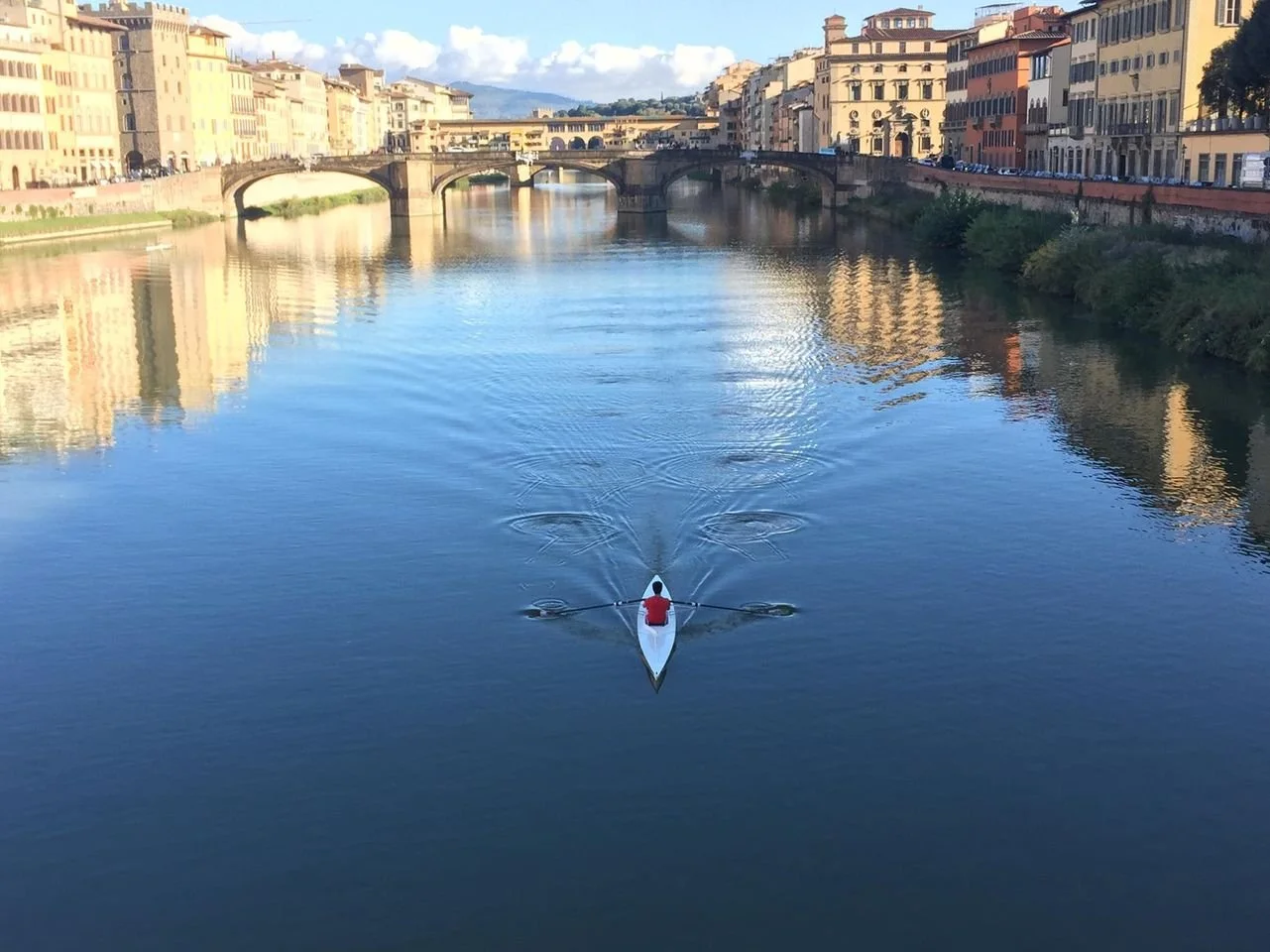
(A rower in Florence calmly advancing surprisingly fast)
On a morning walk in the woods, I at times find myself caught in this inner rush, feeling haunted to get it over with so I can get to my desk.
And while I like an energetic start to the day:
It's a fine line between feeling inspiringly drawn towards what's next and feeling hurriedly pushed along.
Eliud Kipchoge, a legend in the running world and one of the fastest marathoners in history, is renowned for his impeccable ability to maintain a consistent pace. During his record-breaking attempt to run a marathon in under two hours (at the INEOS 1:59 Challenge), he ran each kilometer within a second or two of his target pace.
While this wasn’t a standard race and therefore not an official world record, it was a testament to his mastery of energy management over long distances. He once said: "Only the disciplined ones are free in life."
What if discipline isn't about being as fast as possible in any given moment, but about finding the most efficient pace to maintain long-term energy for our daily tasks?
What if this discipline is our key to the freedom to maneuver our life's explorations, feeling like we're in the driver's seat?
What if it’s not about getting through that morning walk by pushing for top speed, but pacing it to fuel most efficiently for the next steps on my agenda?
What if our pace defines the energy we can maintain throughout our day?
If we consider circumstances the hardware, the pace we tackle them with might be one of the most incremental software decisions.
Managing our pace well expands the energy levels of how long we can keep going.
Maybe when we have an intimidating goal ahead, the most crucial aspect is to shift from "ASAP," as in "As Soon As Possible," to "As Sensible As Possible" to maintain a sustainable rhythm.
Warren Buffett, known for his methodical approach, once said, "No matter how great the talent or efforts, some things just take time."
Regarding a run, a stated goal, or daily tasks, I often sense that long-term success is about surrendering to that sweet spot of natural timing.
It's about finding that long-term consistency to be sustainable. It's about finding that balance between pushing forward yet not overheating the engine for it to break down. It's about distributing our energy as effectively as possible to maintain momentum.
It’s also about knowing when to take a break and that break being well-paced: long enough for us to regain energy, but brief enough to not lose momentum. It can be a subtle tipping point to catch, getting back to our task just before our attention trails off.
On a personal note, I’ve explored how maintaining interest and energy to keep going comes from shorter slots. It sometimes feels paradoxical to take a breather when I feel the pressure to advance or could easily go on. Yet, that brief intermission has often turned out to speed up the overall process.
In fact, science backs this up. A well-known study on sustained attention suggests:
Taking short, strategic breaks can actually reactivate our ability to focus.
The brain's attentional resources drop after long periods of single-task focus, so those short breaks—even just a minute or two—aren't a sign of weakness; they're a key part of maintaining long-term productivity and staying engaged.
In endurance cycling, especially multi-stage races like the Tour de France, there is often mention about the breaks between stages being absolutely crucial. It doesn't seem to come down to the fastest rider on any given day, but to the rider and team that can recover most efficiently, maintaining a sustainable pace over weeks while minimizing accumulated fatigue.
Usain Bolt, the fastest man in the world, surprised me in an interview by emphasizing the importance of pacing in training, saying, "I know my limits. I pace myself."
Inserting Little Energy Surges
Lao Tzu wisely said: "Nature does not hurry, yet everything is accomplished."
What if haste actually diminishes our capacity to advance most efficiently?
What if the stress of feeling "behind" a timeline is a sign that the timeline needs to be adjusted?
When working at my laptop, I get up after a dedicated amount of time—saved by the bell of a set alarm—to stretch the tension from my neck and shoulders, shaking the "sitting energy" from my body. At times, I switch between sitting and standing when writing to counter the cramps I get in my inner hip.
A body therapist friend of mine taught me to walk around, straightening my head after staring at the screen for a while. It's about countering the habitual slouch I easily get stuck in by adapting the posture of carrying goods on the head, the way it's common in some African cultures.
Have you ever observed what works best for you?
Do you realize when your body is slouching over the keyboard? Are you aware of the tensions around your neck, causing chronic headaches? Do you notice how your jaw is clenching? Are you countering your fatigue with coffees, cigarettes, or getting up to stretch?
Do you catch yourself when you go from consciously being engaged to coasting along on autopilot? Do you even notice when your attention starts to waver?
How are you spending those hours you clock?
It's surprisingly doable to seem engaged while passively passing scheduled time. I've seen it countless times when passing through an open office, with corners of social media profiles or shopping sites peeking out behind the main frame. It's been bewildering at times how I "just wanted to quickly look something up" and found myself watching dog videos half an hour later...
What if pacing our work more considerately keeps us from wanting to go into constant escape mode?
What if the amount of work isn't the issue but the way we distribute our attention? What if we merely need to find our most efficient mode of driving our day, as if choosing between Eco or Sport in a car?
What if working on a task without a limit is counterproductive?
What if a shorter but focused meeting is more impactful than spending a longer amount of time together merely for the sake of it?
In what way does pacing improve our overall energy levels?
Haruki Murakami, the multi-bestselling author and marathon runner, is known for his disciplined approach to writing and running. In his memoir What I Talk About When I Talk About Running, he emphasizes the importance of pacing in both.
When he's working on a novel, he wakes up at 4:00 AM and writes for about five to six hours. He typically runs for 10 kilometers or swims for 1500 meters in the afternoon, claiming this physical activity is not just exercise, but a crucial part of his creative practice, as necessary as artistic sensitivity for a writer.
The best advice he's given about staying consistently engaged seems to be all about repetition and rhythm. He keeps to this routine every day, without variation, for months at a time, calling it a form of "mesmerism" that allows him to reach a deeper state of mind. He believes that by consistently showing up, you build the mental and physical stamina needed for long-term creative work.
Turns out that closing my laptop when I feel I could still keep going often leaves me with an inner tickle to get back to it that fails to show when I run down my battery fully.
Gaining by Losing Speed
In Spain, I learned from a local friend to walk a lot slower than I set out to do when we went for lunch during the searing heat of summer in the high 40s. Pacing our tempo reliably turned out to conserve more energy than attempting to quickly get through the heat.
On bigger tours with mountain guides, I have repeatedly been surprised by them setting a pace that is slower than what many of the participants would start with. It's taught me a lot about sustaining a moderate tempo over a long stretch instead of burning energy reserves too fast and having nothing left for the final ridge.
I've encountered countless 80-year-old touring-skiers in retro outfits calmly making their way up the slopes in the high Alps. They're often overtaken by hectic fellow tourers half their age, decked out in fancy gear. Nevertheless, the steady-paced veterans often reach the desired peak ahead of their younger counterparts. They arrive rested and ready to tackle the next peak, while the formerly sprinting group needs serious recovery time, huffing and puffing upon arrival.
Pacing the Details
It's dawning on me in practice that lots of things flow better when I slow down (not claiming this to be an easy task). Think about how a river carves a canyon—not by a sudden rush, but by a persistent, steady flow over a very long time. Or consider a tree—its growth isn't a single burst, but a slow, continuous expansion in every direction.
When I was contemplating with a friend how to tackle an intense anxiety heading towards a deadline at a corporate workplace on a lunch break one day, she noticed me wolfing down my sandwich and drily pointed out, "Maybe you should start by chewing slower."
I've been discovering how literally slowing down a movement can take out the stress. So, when I am irritated to the point of peeling into my thumb with the potato peeler while making dinner, it's literally about cutting the vegetables more calmly to evade the scars from a lack of precision.
The act of slowing down is about bringing your full attention to the present task, rather than letting your mind rush ahead to the next one.
It's a core principle of practices like Tai Chi, where every movement is deliberate, the same way Zen tradition encourages "mindful action," building heightened attention and awareness through reduced speed.
Similarly, my father tends to practice piano passages of a fast tempo in slow motion, as he calls it. He claims that the reduced pace more impactfully settles the complexity of a difficult passage in the fingers.
A friend of mine who is a dancer always has sessions where the ensemble works through a whole routine at half speed, as muscle memory is built more precisely at that slower tempo.
The legendary basketball coach John Wooden urged teams to "be quick, but don't hurry."
This turns out to be a great instruction for getting through a text when time pressure is an issue. Slowing down my reading pace helps me regain focus to grasp the task faster overall. Often, it's a signal to slow down when my breathing speeds up. Consciously slowing it down has an instant calming effect on my nervous system.
When inner turmoil makes me want to run, the best thing to do is to stop in my tracks for a moment. Turns out:
At times slowing down is the fastest way forward.
Consider the classic story of the tortoise and the hare: A speedy hare boasts about how fast he is and challenges a slow tortoise to a race. The hare zooms off far ahead, gets cocky, and decides to take a nap, thinking he has plenty of time. Meanwhile, the tortoise just keeps plodding along, slowly but surely, without stopping. When the hare finally wakes up and rushes to the finish line, he's shocked to find the tortoise has already crossed it.
This simple fable plays out in real life every day:
It's often paced progress, not a frantic rush, that leads to a desired finishing line.
Be it reading 5 pages of a book daily, walking 20 minutes in the morning, or writing a few lines every evening—it accumulates surprisingly fast when we stay with it. Like in the fable, it's the consistency that often outlives the unstructured bursts of speed, which can easily lead to losing precision and, most importantly, the enthusiasm to keep going.
When running a marathon, it's not rare to have runners whiz past me at an early stage, only to see them off to the sides barely catching their breath on later stretches of the race.
And while we will always be asked by life to put in the occasional sprint, pacing ourselves might turn out to be a key factor for reaching the finishing lines we are eagerly heading towards.
Have you asked yourself:
How long can you focus on something?
When is that moment, right before you trail off, that hints for a break?
Do you catch it?
Do you catch yourself starting to run when you are stressed?
Do you slow down?
What is the effect?