What if Our Reality is a Constant Transition?
/trænˈzɪʃ(ə)nɪŋ/
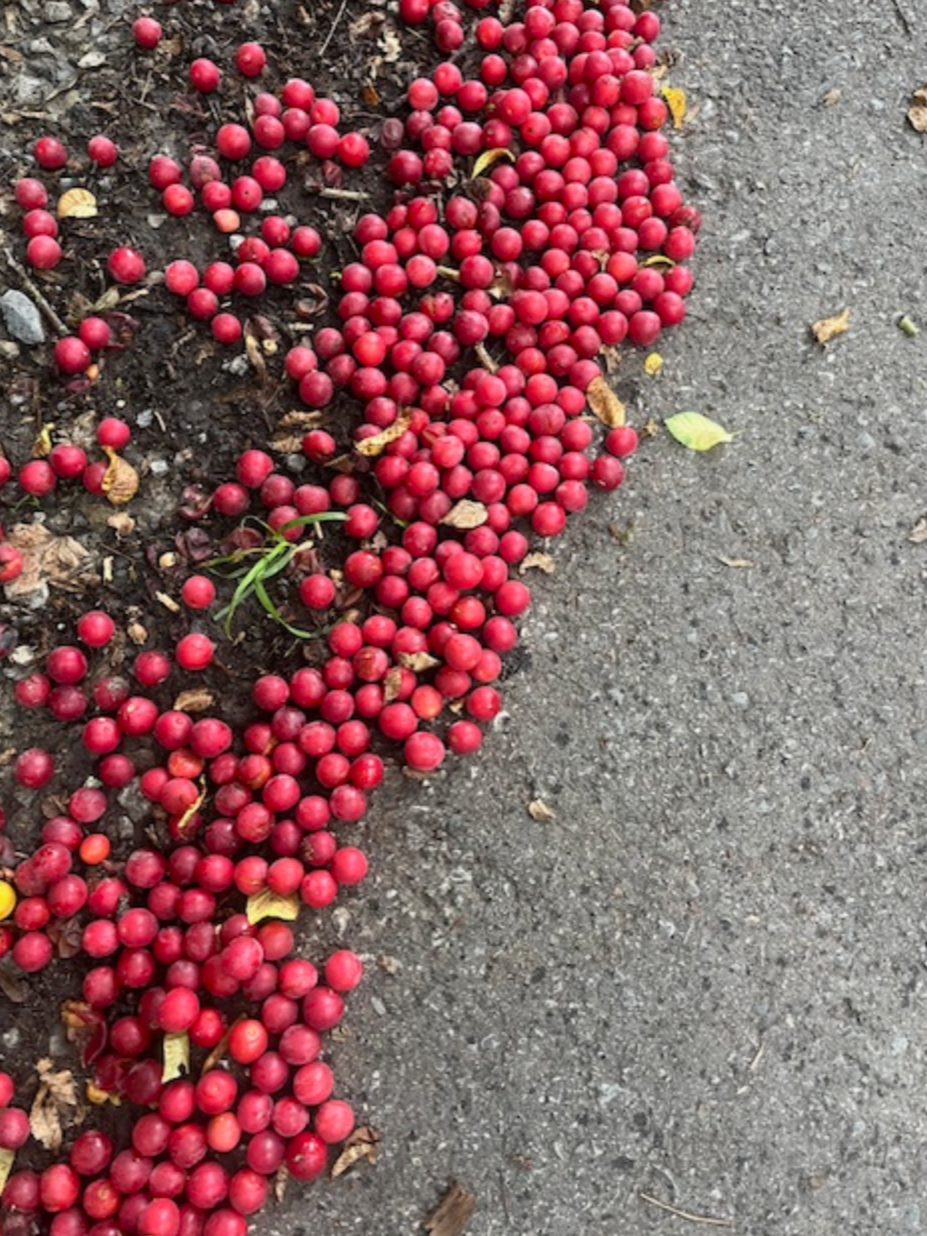
(nature transitioning the paths of a fall walk)
When doing some back exercises this morning that I hadn't done for a while, I was caught off guard yet again by my body refusing to accept a solidified state of fitness. I might also just have forgotten the concept of muscle "memory," as in our body liking to be engaged ongoingly, not held accountable to an illusionary solid standard.
It was a blunt reminder that we're constantly starting over. It also made me ponder that expecting to solve problems finitely is the fastest way to stop evolving and a reliable path to constant frustration.
It took me a while to get used to the Buddhist notion that “life is suffering,” as it initially seemed rather bleak. Yet, the more I find myself bewildered by our culture of wanting to attain constant happiness, solidly fixed youth, and a state of ever-present gratification, health, and wealth, I wonder if expecting things to go pear-shaped might be a less frustrating path.
What if the way out of our misery is to cease chasing a solid state of eternal bliss?
What if we exchange incessant wanting for the curiosity to explore?
What if we drop our expectations towards life and listen to what life asks of us in a playfully intrigued way?
Nobel Prize Winner Henri Bergson stated that "to exist is to change, to change is to mature, to mature is to go on creating oneself endlessly."
What if “the obstacle being the way,” as stated in Zen culture, is a more accurate grasp of the nature of life's constant transition than wanting to remove our apparent obstacles altogether?
What if there is a point to seeing life as constant change?
What if the antidote to feeling chronically anxious about never arriving in a state of permanent relief is to focus on the process instead of the outcome?
What if we release the idea of a solid state of security and stability in a world countering that notion, the same way our mind does not seem capable to adapt the idea of “enough”?
What if we saw life as a continuous flow of experiences that create an energy we carry with us to tackle our current day? What if it's more about how we process the next moment than about getting stuck in incessant planing for a future on a far-off horizon?
The permanence of a tattoo that no longer lines up with our state of being can be a rather amusing reminder when we find ourselves wondering about why we thought we would always feel about it the same way.
What if Life is a Transitory State?
You know the feeling when you're engrossed in an enjoyable activity and time seems to fly by? Or, conversely, when you're anxious or bored, and time seems to crawl? Turns out, "duration"—time as experienced by consciousness—often has a way bigger impact on our perception than measurable clock time.
It's been attributed to Einstein that he quipped about the relativity of perceived time: "When you sit with a nice girl for two hours you think it's only a minute, but when you sit on a hot stove for a minute you think it's two hours. That's relativity."
It's this relativity that determines our personal reality. This subjective nature is highlighted when we get caught between clinging to what we don't want to lose and worrying about not getting what we want. It's why we go after what we know and try to avoid what triggers fear of uncertainty.
It's this struggle that can turn out to be a huge distraction from actually being where we are.
It's the understanding of this struggle that can help us regain courage to be present along with the inevitability of constant transition.
What Happens When We Lean In?
What if we embrace our daily explorations as ongoing transition instead of draining our energy by trying to control what can't be controlled?
What if leaning in is about dropping resistance and getting out of the way?
What if we approach our bodies as the dynamic systems they are, instead of treating them like something we need to get into an idealized solid shape, fix, or change altogether?
What if we engage with our work as an inspiring process of development instead of seeking external confirmation through appraisal? What if we focus on our internal progress rather than on a promotion or a title we then spend worrying about losing?
As Alan Watts, renowned for popularizing Eastern philosophy, encouraged us: "The only way to make sense out of change is to plunge into it, move with it, and join the dance."
There are many areas in science and nature that don't doubt transition being the way forward. Evolution is defined as an ongoing transition of species adapting to new environments. Charles Darwin poignantly stated: “It's not the strongest of the species that survives, nor the most intelligent that survives. It is the one that is the most adaptable to change.”
Think of the peppered moth in 19th-century England. As industrial pollution darkened the tree bark, the light-colored moths were easily eaten by birds. Within a few decades, the darker-colored moths, which were better camouflaged, became the dominant species. Their survival wasn't due to superior strength, but to a timely transition in coloring.
Our own brain's neuroplasticity is a testament to the brain's inherent flexibility, allowing us to adapt throughout our lives. The process suggests we can transition whatever we felt certain about until the last day of our lives.
It also implies we can always learn, unlearn, and relearn, to the degree that we stay engaged with that dynamic.
Frequently, when I re-read something I wrote a while back, I find myself wondering: “who wrote this?” It's amusing as much as it can be bewildering. It's as intimidating how much we do seem to constantly transition as it's inspiring to see how we evolve from where we were a while back. When I find myself seriously worried, I sooth myself with the notion that It would be rather disturbing if I thought the same about something I did 10 years ago.
Yet admittedly, despite the liberating ring to change, I often find myself resisting with full force. It can take me a while until I feel it might not be as scary as I suspected.
What Makes it so Challenging?
This resistance to change manifests in the most mundane ways. A friend and I recently chuckled as she refrains from putting on long pants as long as she can after summer, showing up in shorts with a huge sweater and wool socks on bare legs. On my end, I had to admit to catching a cold, as I tend to stay barefoot a lot longer than advisable.
And then there are the times when life asks us to transition in an overwhelming way. It's those moments we need to let a relationship end, or accept that a person we feel close to is dying. It's the moments when life asks us to get deeply acquainted with the inevitable fleetingness of our brief existence.
Stephen Hawking, confronted with intense transitions due to his ALS diagnosis, so aptly puts it in Brief Answers to Big Questions: "Intelligence is the ability to adapt to change."
As excruciating as what life asks of us can be, what if the resistance to it creates deeper pain than the challenging journey towards acceptance?
Lacking confidence in my capacity to transition is something I've hustled with countless times. Be it remaining in my last romantic relationship way beyond deeply suspecting it had run its course. Be it sticking with a rigid running schedule my body was painfully opposing. Be it stubbornly insisting on past conditioning that gravely blurred my present view.
In many cases, this "delay" eventually made the transition rather abrupt, reminding me of Jack Welch's advice to "Change before you have to."
Yet, what if at times that's simply the utmost courage we can muster up?
As much as I engage in that unhelpful mechanism, I feel strongly about not holding our past against us. Meaning, we ultimately transition when we can.
And it reliably turns out, life knows when inevitable transition is on the agenda, and none of us will get away. It just sometimes comes with a bit of a bang - The force of the bang proportional to our resistance.
Having moved countries five times, I've learned that every external move demands the acceptance of countless shifts that are often unsettlingly confusing before their rigid edges soften.
Being in a new environment has made me feel vulnerable, insecure, flawed, sensitive, overwhelmed. Yet as the famous line “this too shall pass” proclaims, it's also what eventually makes me realize how adaptable we are.
What We Gain by Letting Go
What if the wisdom of “It's always darkest before the dawn”—implying that things always look difficult before they are easy—has an underlying truth to it that plays in our favor if we dare leap?
What if we muster up the courage to transition to the degree that we bravely hustle with it in the first place?
And what if we lack the energy we need for a new situation as it’s often stuck in resisting whatever needs to be let go?
While looking in the rear mirror like when we're driving has its place for orienting ourselves, only focusing our gaze backwards will eventually make us lose our way or even crash.
A Chinese proverb suggests: "When the winds of change blow, some people build walls and others build windmills."
What if by getting stuck in resentment we block the potential for building something new?
While even the smallest transition can feel daunting, is it also a chance?
What if endings are often beginnings in disguise? What if they are often prerequisites for us to evolve?
What if when people and circumstances exit our lives, we treat it as a process of a bigger development rather than something radically final?
Have you ever noticed when someone leaving your immediate surroundings turned out to make space for an unexpected new encounter? What if we are overlooking a rather logical correlation:
To evolve you have to let go of wanting things to stay the same.
What if you are sometimes blocking an opening as you are not closing a case? What if your attention is literally stuck in the past instead of being available to transform you beyond your current state?
What we can Learn from Being Called Out
Do people at times comment on you having changed? What is your innate inner response to that? Do you feel criticized as I easily do, conditioned to take this as a criticism of no longer fulfilling the expectations of who I am “supposed” to be? Do you realize that it might be a twisted compliment of someone acknowledging you no longer are rolling with the familiar they might be questioning themselves?
What if it turns out that you have indeed moved on from the person you were? Does this feel unsettling at first? Do you feel bewildered by not recognizing yourself as you had thought about yourself so far? Do you feel guilty of breaching boundaries? Do you take a moment to question where those boundaries came from?
What if you have outgrown who you were, like a plant needing to be repotted as the older restricted home is no longer sufficient?
Transition being a Release
On a relieving upside, while losing what we have become familiar with can be daunting, transitioning can also release situations that are hard to bear. Yet again, “this too shall pass” is what we can bank on.
What if we are underestimating the silver lining?
What if what seems so intimidating is also our way beyond the most painful situations?
What if there is hope in knowing that however hopeless we feel this moment, there is the guarantee of transition on the horizon?
What if learning from what we have overcome is a self-propelled source to gain confidence? What if the process is a self-sustaining mechanism building resilience? What if each transition strengthens our ability to adapt to future transitions, increasing our capacity to do so?
Dr. Gabor Maté reminds us in In the Realm of Hungry Ghosts: “The possibility of renewal exists so long as life exists.”
What if approaching life with open-ended curiosity is like constantly enabling the seeds for our next phase of growth?
A friend said to me today that she has been clearing her space to gain clarity and is excited to go through her next phase lighter and more curious. It felt like a summary of transitioning with more ease.
What if by regularly stepping out of your comfort zone in the smallest ways, we build our muscle of adaptability? What if, like when doing my exercises, it's about integrating that practice as a way of living, not a way of expecting to arrive at a solid state?
Embracing transition doesn't mean we won't face challenges or discomfort; It's rather about getting comfortable with being uncomfortable. Choosing curiosity over rigid expectations for an outcome. Leaning into the flow of life rather than burning our energy by constantly swimming against the current.
And most importantly, while it's one of the most daunting things to accept, ongoing transition is our biggest reason not to lose hope.
Have you asked yourself:
Are you worried about losing what you have?
Are you struggling with accepting the pace at which things are going?
Can you warm up to the idea that you are exactly where you are supposed to be right now?
What happens when you resist?